
Key takeaways
- Social signals still aren’t a Google ranking factor. Google has said so for about a decade. AI search reopened the question, because large language models read social content directly and cite it in their answers.
- LinkedIn was the most-cited source in our AI Citation Index for eight of nine C-suite personas. Of the LinkedIn citations we coded, 78 percent pointed to content published by users. LinkedIn’s own corporate content drew just 3 percent.
- LinkedIn still made up only 5 percent of the 154,944 citations we collected, and community platforms like Reddit and Medium lost their citation spots far faster than authoritative sources. Social works best as an amplifier for credibility a brand has already earned in trade press, analyst research, and its own content.
Every few years, someone in a marketing Slack channel asks whether likes and shares help a page rank, and every few years the answer comes back no. I’ve watched this cycle long enough to feel a little fond of it. The question is back now in new clothes. People want to know whether their LinkedIn posts will get their brand into ChatGPT (or Claude or Gemini or Perplexity or…).
This time the answer is closer to yes, which is what introduces some new risks. In our C-Suite Signals: AI Citation Index, we ran 1,125 C-suite prompts through ChatGPT, Claude, Gemini, and Perplexity over four weeks, and LinkedIn emerged as the single most-cited source for eight of the nine executive personas we tested.
This is the third installment of our Silver Bullet series, where we look at various disciplines — SEO, paid, social media, and PR — and ask what each channel can (and can’t) do for AI visibility. Keep reading to see how social should factor into your AI visibility efforts.
Do Social Signals Affect SEO?
You may be reading this and rubbing your eyes: Why is Lauren talking about SEO? Isn’t this blog post about GEO? Yes, but SEO impacts GEO. And if social impacts SEO, we have that transitive chain of logic (Social > SEO > GEO).
But that transitive logic may be for nought. For traditional Google rankings, the answer to “does social affect SEO?” hasn’t moved in years (yes, really). Google’s John Mueller said in 2015 that social signals aren’t a direct ranking factor. His colleague Gary Illyes was less diplomatic in 2017, calling the idea that search engines rank you better because of social “BS.” Most links in social posts carry a nofollow attribute, so they pass little or no PageRank. The major SEO publications that track ranking factors have landed in the same place. Google flirted with social signals in the early 2010s, and a few correlation studies kept the myth alive for years after.
What social actually does for SEO
Some marketing guides still blur this and imply that shares and follower counts push a page up the results. I get the appeal. It would make social a lot easier to justify. The benefits that do exist are indirect. Social distribution puts content in front of people who might link to it, search for your brand by name, or mention you somewhere that counts. Google’s Search Quality Rater Guidelines also tell its human evaluators to consider social profiles when they assess a creator’s reputation. Those effects are real, though they’re slow and hard to attribute.
If you were hoping I’d say social signals for SEO are back, I can’t. What I can say is that AI search changed the mechanics enough that the old answer no longer covers the whole question.
Do Social Signals Affect AI Visibility?
A ranking algorithm decides which page to show you. A large language model (LLM) reads pages, pulls passages out of them, and writes an answer. It doesn’t much care whether a passage came from a publisher’s website or a LinkedIn article. When an AI platform searches the live web, a well-written LinkedIn article is one more document it can retrieve and cite.
That matters because of where buyers now start. According to G2, half of B2B decision-makers begin research with platforms like ChatGPT more often than with Google. Whatever those platforms cite is, in practice, the first draft of your brand’s reputation.
LinkedIn leads AI citations for the C-Suite
Our C-Suite Signals: AI Citation Index shows how much of that first draft comes from LinkedIn. Across 154,944 citations collected from C-suite prompts, LinkedIn was the top source for every persona except our Chief Medical Officer, where PubMed led. It outranked Gartner for the CMO and CRO, Deloitte for the CFO, SHRM for the CHRO, and Forbes for the global head of communications. Profound found the same pattern from a different direction. Across six AI platforms, LinkedIn was the most-cited domain for professional queries, and its domain rank on ChatGPT roughly doubled between November 2025 and February 2026.
Press releases barely register in AI search
Compare that with the humble press release. Wire services and PR distribution platforms made up under two percent of the citations we categorized. If your product launch only exists as a wire release, AI barely registers it. Put the same news on LinkedIn and in the trade press, and it has a real shot at showing up.
So social content feeds AI visibility much more directly than it ever fed Google rankings, which makes it worth knowing exactly what AI is reading on LinkedIn.
Related Read >> GEO vs. AEO vs. AIO vs. SEO: What’s the Difference?
What Kind of LinkedIn Content Does AI Cite?
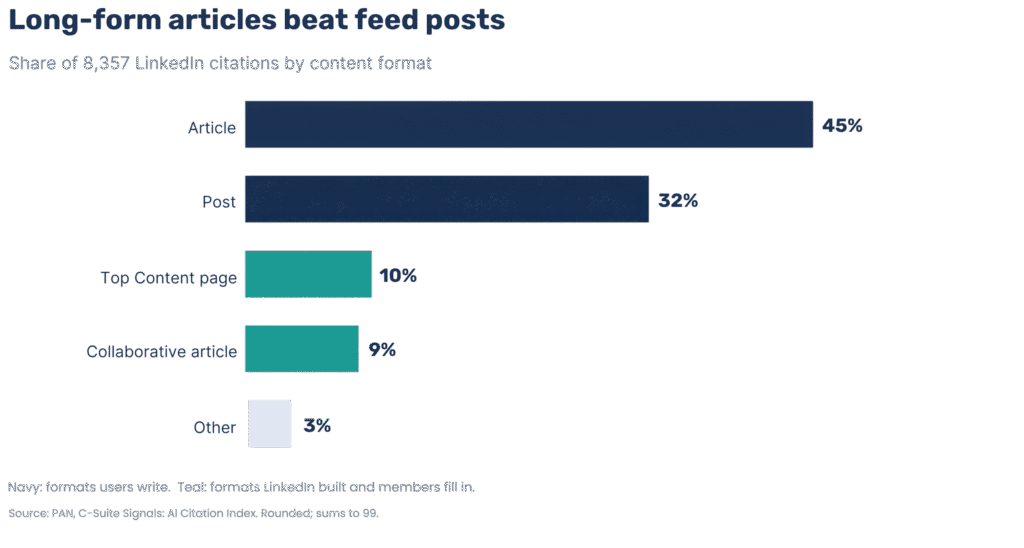
We broke down 8,357 LinkedIn citations from the Index by format and by who published the content.
| Format | Users | LinkedIn corporate | LinkedIn-built, user-filled | Total |
|---|---|---|---|---|
| Post | 2,688 | 0 | 0 | 2,688 (32 percent) |
| Article | 3,634 | 159 | 0 | 3,793 (45 percent) |
| Collaborative article | 0 | 0 | 784 | 784 (9 percent) |
| Top Content page | 0 | 0 | 857 | 857 (10 percent) |
| Other (job listings, company pages, etc.) | 166 | 69 | 0 | 235 (3 percent) |
| Total | 6,488 (78 percent) | 228 (3 percent) | 1,641 (20 percent) | 8,357 |
Articles outperform posts
Articles beat posts. There ya have it! Long-form LinkedIn articles drew 45 percent of LinkedIn citations, compared with 32 percent for feed posts. That lines up with something else we saw across the study. AI platforms break content into passages and lift the ones that make sense on their own. A 1,200-word article with a clear argument and a few specific numbers gives a model far more to work with than three lines and a link.
Posts still earned about a third of LinkedIn citations, so the feed is worth the effort. The posts with the best shot are the ones built like short articles. They make a specific claim, show the evidence behind it, and give enough context that a reader (or a model) can follow it without the comment thread.
Users write what AI cites
The bigger surprise for me was who wrote the cited content. Nearly four in five LinkedIn citations (78 percent) went to content published by users, meaning the people and organizations actually posting on the platform. LinkedIn’s own corporate content accounted for 3 percent. Another 20 percent went to formats LinkedIn designed and members filled in, like collaborative articles and Top Content pages, which are essentially LinkedIn’s way of packaging individual expertise so search engines can find it.
Profound’s data points the same way. Between November 2025 and February 2026, LinkedIn profiles fell from 33.9 percent to 14.5 percent of LinkedIn citations in ChatGPT, while posts and long-form articles together rose from 26.9 percent to 34.9 percent. AI is citing what people write on LinkedIn more often and who they are on LinkedIn less often.
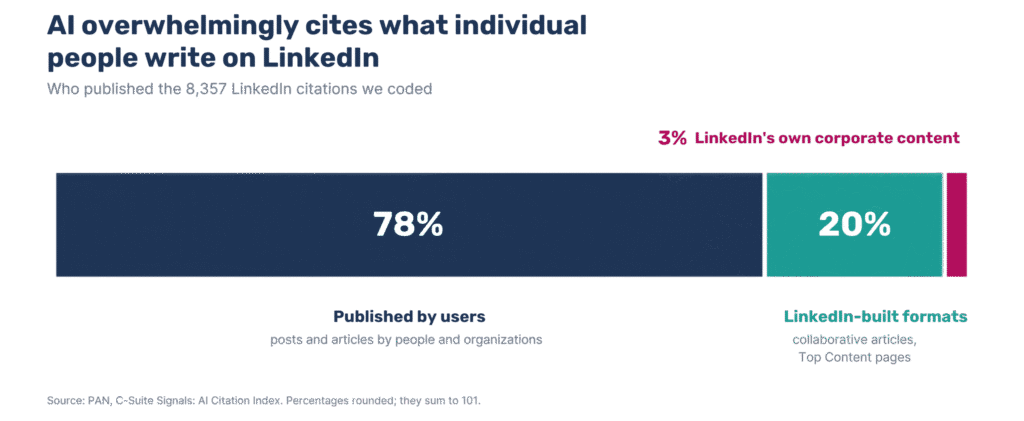
For B2B brands, the lesson is that AI cites contributions. A careful article from your CISO about a specific threat pattern she’s seeing is citation material. A company page post about how thrilled the team is to share a new partnership mostly isn’t. (We’ve made a version of this argument before. AI appears to hold the same standard buyers do.)
Why Social Media Still Isn’t a Silver Bullet for AI Visibility
LinkedIn is only 5 percent of the answer
LinkedIn was the most-cited source in our study, and it still accounted for only 5 percent of all citations. Those 154,944 citations came from 16,503 different domains, and it took 786 of them to account for half. Being the biggest fish in that pond leaves 95 percent of the answer to everything else: trade publications, analyst firms, government and association sites, vendor documentation, review sites, and forums.
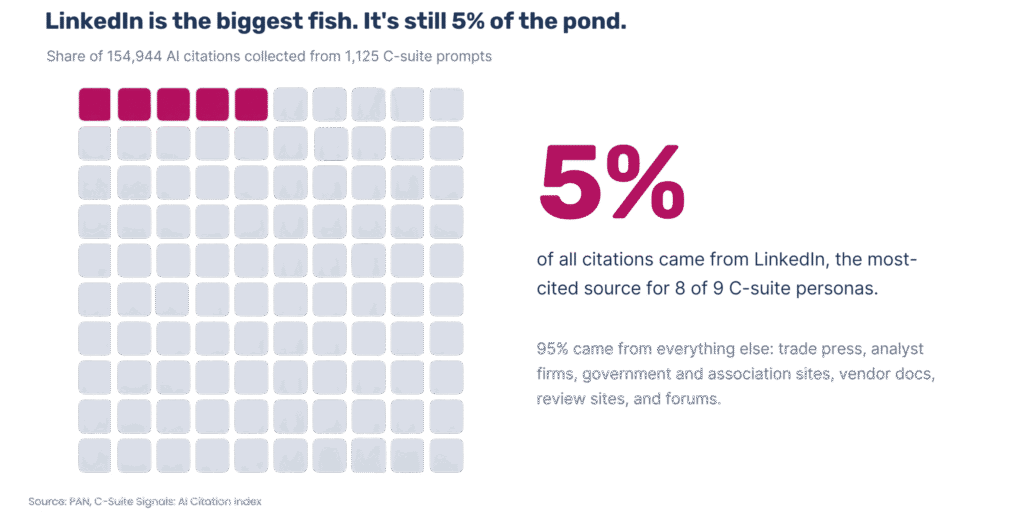
LinkedIn’s share also shifted a lot by audience. It took 8.2 percent of citations for our global head of communications persona and 6.9 percent for the CTO/CIO, compared with 4.6 percent for the CFO. For the Chief Medical Officer it dropped to 2.3 percent, while NIH/PubMed alone took 22.6 percent. How much LinkedIn matters depends on who your buyer is and where their field already does its reading.
Social citations don’t last
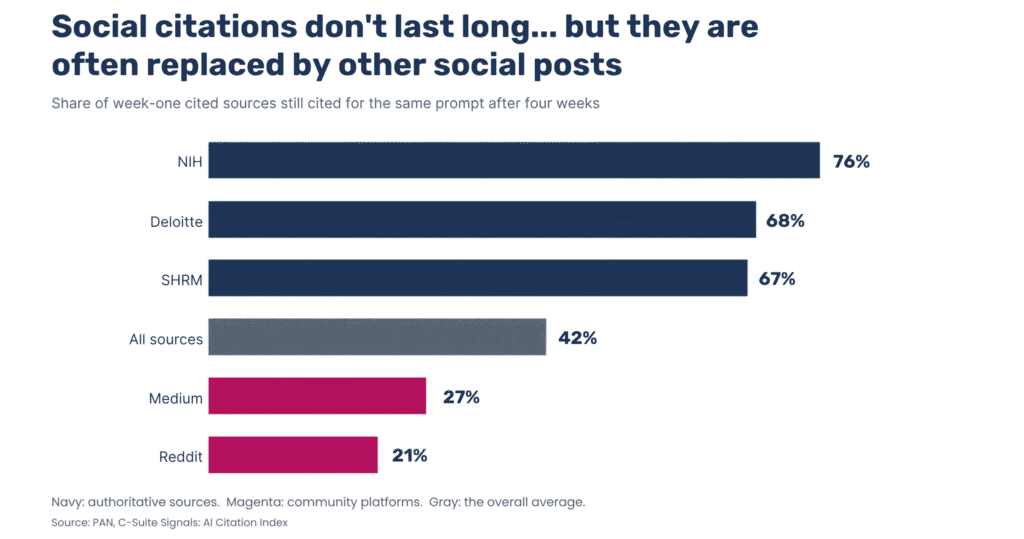
We also tracked whether a domain cited for a given prompt in week one was cited for the same prompt in later weeks. Overall, only 42 percent of the original sources were still being cited after four weeks. Authoritative sources held on much better. NIH kept 76 percent of its spots, Deloitte kept 68 percent, and SHRM kept 67 percent. Reddit and Medium started out cited about as often as NIH, and they kept 21 percent and 27 percent.
That gap is the clearest case I can make against treating social as the whole strategy. Community and user-generated platforms get pulled into AI answers quickly and dropped just as quickly. Profound’s research on citation lifecycles found that the median page loses half its citation share within 11 days of peaking. A lot of social content lives on that short clock. Earned coverage and analyst research seem to run on a longer one.
The same prompt gets different answers
The answers themselves keep moving, too. In our research, 50.4 percent of identical prompts produced a substantively different response when asked again in the same session, and 57 percent did when asked again over four weeks. A LinkedIn post that gets cited once is one draw from a wide range of possible answers. Showing up across that range takes presence in many places at once.
Engagement stays on the platform
There’s also a quieter problem with the phrase “social signals” itself. In SEO circles it usually means engagement, the likes, shares, and follower counts. Retrieval systems work with text. A model quoting a LinkedIn article uses the argument in it, and the like count stays behind on the platform. Engagement still matters indirectly, because a widely read article gets repeated, referenced, and linked elsewhere. That’s the same slow, indirect path social has always taken in SEO. It just runs through a few more places now.
Related Read >> What Is Social Proof? Why PR Is Your Most Reliable Source of It
How to Grow Your LinkedIn Page’s Signal for AI
None of this is an argument for ignoring LinkedIn. It’s an argument for being specific about what you’re building there. If your goal is signal growth on your LinkedIn page, the page itself is a small part of the job. These are the places I’d spend the effort.
Put your experts’ names on long-form work
Articles outperformed posts in our data, and most citations went to content users published. Pick two or three executives or subject matter experts whose expertise matches the questions your buyers ask AI, and give them a regular cadence of LinkedIn articles on those topics. Match the voice to the buyer. LinkedIn led citations for CISOs, CFOs, CROs, and CHROs alike, so a CFO-facing brand needs a finance voice publishing there.
Write passages AI can lift
Every platform we tested organized its answers in a rigid structure, whether that meant Claude’s and Gemini’s section headers or Perplexity’s bulleted footnotes. Give your articles clear subheads, state the claim at the top of each section, and include the specific number or example that makes it worth citing. The foundational research on generative engine optimization, from Princeton, Georgia Tech, the Allen Institute for AI, and IIT Delhi, found that adding statistics and authoritative quotations raised visibility in generative engines by 30-40 percent.
Treat your company page as the “hub”
The page earns its keep by connecting your people and your brand. Reshare employee articles with real commentary instead of a bare repost. Make sure the page’s description uses the same positioning language as your website and press materials, since mismatched descriptions are one of the ways AI ends up blending two versions of your brand. Connect your website and LinkedIn presence with sameAs schema so search engines and AI systems can tell they belong to one organization.
Give earned coverage a second life
When you land trade coverage or an analyst mention, have the relevant expert publish a LinkedIn article that adds their perspective and links to the original. Your claim now exists on an authoritative domain that holds its citation spots and on the platform AI cites most for professional questions.
Timing helps. Publish the follow-up while the coverage is fresh, and have the expert add something the original story didn’t have room for, like a data point, a customer example, or a disagreement with a competitor’s take. A bare link to the article is a repost. An article with new substance gives AI a second source to work from.
Show up in other people’s conversations
Substantive comments on industry discussions and contributions to LinkedIn’s expert-driven formats put your team’s thinking into content LinkedIn packages for search. One in five LinkedIn citations in our data went to those LinkedIn-built formats.
The comments that count add something a reader would otherwise miss, such as a figure from your own data, a pattern you’ve seen across customers, or a specific objection. Agreement and congratulations give nobody, human or model, a reason to quote you. Spend the time on threads started by the analysts, reporters, and practitioners who already cover your category, since those are the conversations your buyers follow.
Keep the cadence steady
A burst of posting around a launch looks a lot like the coverage spikes we warned about in the PR installment. Given how quickly cited sources turn over, one solid article a month from the same expert for a year will do more than ten posts in launch week.
In practice, that means a calendar built around the questions your buyers ask AI, with each expert owning a few of them. One research asset can carry months of it. A single study can become a series of articles, each taking one finding and explaining what it means for a specific role.
Where Does AI for Social Media Visibility Optimization Fit?
Search “AI for social media” and you’ll mostly find lists of tools that draft captions, pick posting times, and summarize performance. They’re useful, and plenty of social teams lean on them to keep up with volume. They solve a production problem. A faster way to make posts doesn’t change what AI platforms decide to cite, and a feed of AI-drafted copy in the same register as every competitor’s gives a model nothing distinctive to quote.
I’d point AI for social media visibility optimization at measurement instead. Run the questions your buyers actually ask through ChatGPT, Claude, Gemini, and Perplexity, and run each one more than once. Our data says a single answer is roughly a coin flip away from changing, so the number worth tracking is how often your brand and your experts appear across many runs. Note which LinkedIn articles get cited, if any, and whose people show up when yours don’t. That tells you which topics need a stronger voice on LinkedIn and which need coverage somewhere else entirely.
Related Read >> The State of Search in 2026: AI Visibility
What an Integrated AI Visibility Strategy Looks Like
Each channel we’ve covered does one job well. PR puts your brand in the sources AI trusts most and keeps it there, which is why earned coverage and analyst research held their citation spots in our data. SEO and owned content give AI an accurate, well-structured version of your story to retrieve. That matters a great deal when, in our earlier research, roughly one in three ChatGPT citations was misattributed or fabricated. Paid builds the familiarity that makes a buyer recognize your name when AI surfaces it, and it drives the branded searches and engagement that read as market traction. And since AI-referred visitors tend to arrive ready to buy, that recognition has a short path to pipeline. Social, and LinkedIn in particular, gives your experts a voice on the platform AI cites most for professional questions and gives the other channels’ work a place to be repeated and discussed.
Our first post in this series argued that visibility in AI is a symptom of a brand’s full footprint. Four channels later, the data keeps pointing back to it. AI pulls from thousands of domains and swaps out sources within weeks. It changes its answer about half the time you ask. The brands that hold up are the ones telling the same story in trade press, on their own site, in analyst reports, and in their executives’ LinkedIn articles. Whichever source AI grabs this week, the answer comes out close to right.
The full C-Suite Signals data, including the LinkedIn breakdown above, is live now. For the rest of our research on how AI evaluates B2B brands, explore the AI Credibility Hub.
————
Frequently Asked Questions about Social Signals and AI Visibility
Are social signals a Google ranking factor?
No. Google representatives, including John Mueller and Gary Illyes, have said repeatedly that likes, shares, and follower counts don’t directly affect rankings, and most social links are nofollowed. Social can help SEO indirectly by getting content in front of people who later link to it or search for your brand.
Does LinkedIn help with AI visibility?
Yes, more than any other single source in our research. LinkedIn was the most-cited source for eight of nine C-suite personas in PAN’s AI Citation Index. It still accounted for only 5 percent of all citations, so it works best alongside earned media, analyst coverage, and strong owned content.
What type of LinkedIn content gets cited by AI?
In our data, long-form articles drew 45 percent of LinkedIn citations and feed posts drew 32 percent. Content published by users accounted for 78 percent of LinkedIn citations, while LinkedIn’s own corporate content accounted for 3 percent.
Should B2B brands post more on LinkedIn to show up in AI search?
Posting more helps less than publishing better. Prioritize regular long-form articles from named experts on the questions your buyers ask AI, keep your positioning consistent with your website and press coverage, and pair LinkedIn activity with earned media in sources AI keeps citing over time.