
You’ve heard the story before: A brand running an active PR program is landing coverage, placing bylines, and earning analyst mentions. But the brand’s name still barely shows up in AI-generated responses. Worse, AI might even be misrepresenting the brand’s value to prospective buyers.
Both the problem and the solution have a lot to do with how PR and generative engine optimization (GEO) work together.
(Before we get to the meat: If you’re not quite sure what separates GEO from AIO or old-school SEO, take a moment to read our breakdown.)
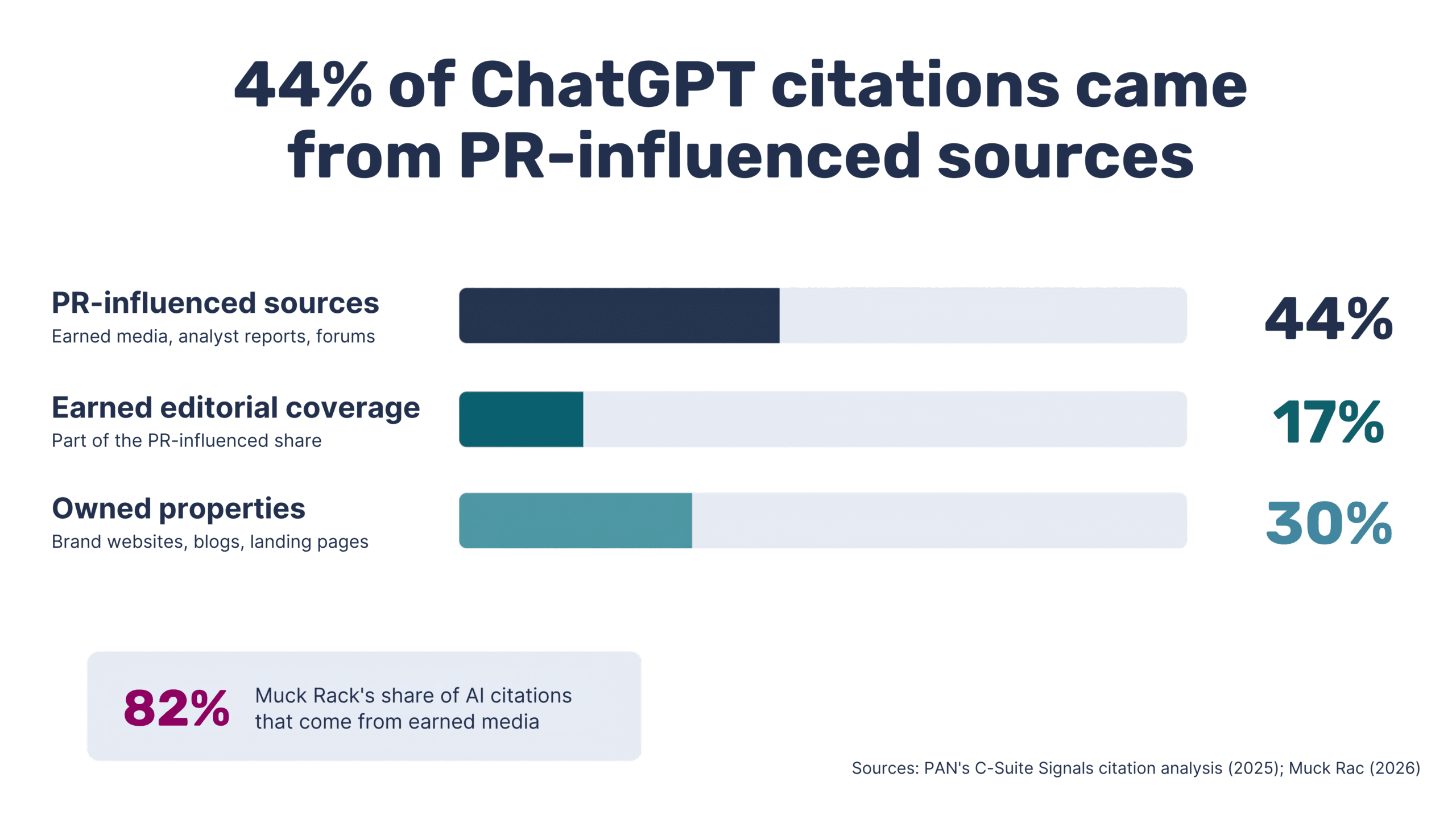
We analyzed more than 15,000 ChatGPT citations and found that 44 percent came from PR-influenced sources. But being part of a category AI trusts is different from being cited throughout the buyer journey.
When 50 percent of senior leaders research vendors with AI before engaging a single sales rep, you can’t afford to wait for your team to share a placement with prospects. Your PR program has to earn your brand a spot in every AI conversation.
Thankfully, most PR programs already have a high signal-to-noise ratio. They just need to crank up the volume, hit the right places, and achieve enough consistency for the AI era. In this installment of our “Silver Bullet” series, we explain how brands can adjust.
How Do PR and GEO Work Together? Why PR Matters More Than Any Other Channel for AI Visibility
Earned media is the number one category AI leans on when deciding whether a brand is credible enough to surface. Our research above showed that AI values sources like earned media coverage, analyst reports, and industry forums. In particular, earned editorial coverage accounted for 17 percent of all ChatGPT citations we measured. Owned properties, by comparison, took up just under a third of the pie.
MuckRack recently reached similar conclusions. According to its research, earned media accounts for 82 percent of AI citations, and journalistic coverage accounts for roughly a quarter.
There are a few reasons why AI relies so heavily on earned media. For starters, the basic premise of earned media is in the name. You’ve proven your brand has something worth saying. A reporter has decided that “something” was also worth publishing. In addition to a placement itself, you’ve also earned a badge of trust that tells a model it can cite with confidence.
There’s also a social-proof dimension to consider. Today’s buyers use AI a lot like they used to use third-party references: as a way to vet a vendor’s reliability. When a buyer asks ChatGPT who leads a category, the model synthesizes what independent voices have said about a brand over time. And when your brand has deep, consistent coverage, there’s a good chance that coverage will permeate an AI model’s training data and retrieval pipeline.
That’s how PR and GEO work together at the most basic level: PR supplies the evidence that your brand is worth trusting, and GEO makes sure that evidence shows up in AI outputs when a buyer asks about you.
Where the Breakdown Between PR and GEO Happens
Picture a PR team at a mid-market patient engagement platform on a meteoric rise. Last spring, they pitched a reporter that got their brand in the Wall Street Journal, the kind of placement most teams spend a career chasing.
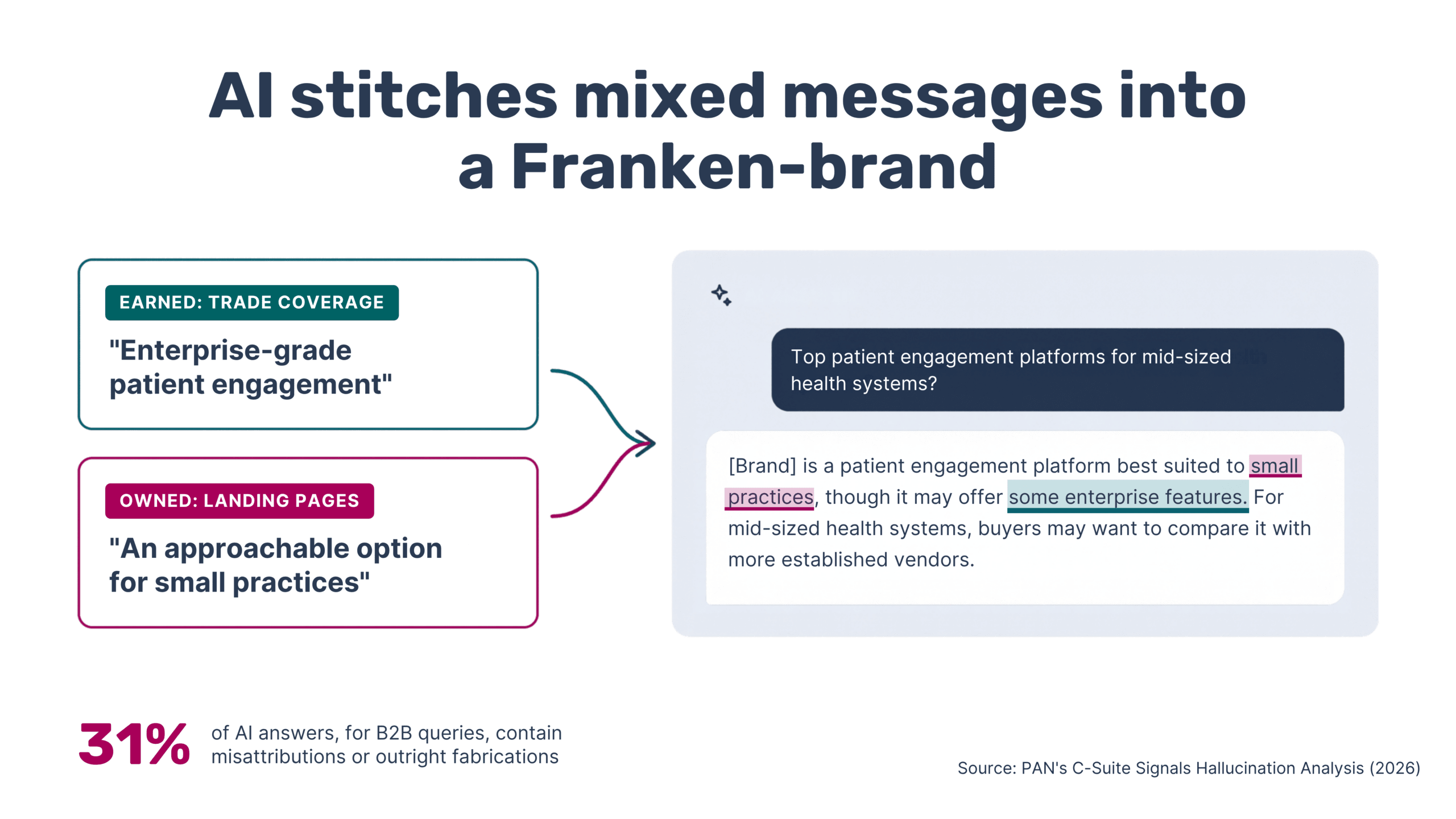
Then, radio silence. No follow-up interviews, no analyst briefings, no new bylines for the better part of a year. When they finally secure some trade coverage, their messaging leads with “enterprise-grade patient engagement,” but several owned landing pages still paint them as an approachable option for small practices.
Their AI visibility is suffering too. At an industry conference, one prospect notes that ChatGPT didn’t list the brand when they asked for the “top patient engagement platforms for mid-sized health systems.” Another prospect is surprised to learn they even offer enterprise-level solutions; Claude surfaced more of the “small practice” narrative.
Most PR programs are designed like this vendor’s: to help brands maximize social impressions or make it into the Journal. But when it comes to securing AI citations, these programs often fail in three important ways.
- Coverage lands in outlets AI doesn’t draw from. Domain authority and citation frequency often use different inputs. Citation behavior is model specific: ChatGPT values authoritative news and earned-media sources, for instance, while Copilot specifically prefers business-friendly sources (like Forbes). So even if a publication ranks well in traditional search, it may not fall within a model’s preferred source pool.
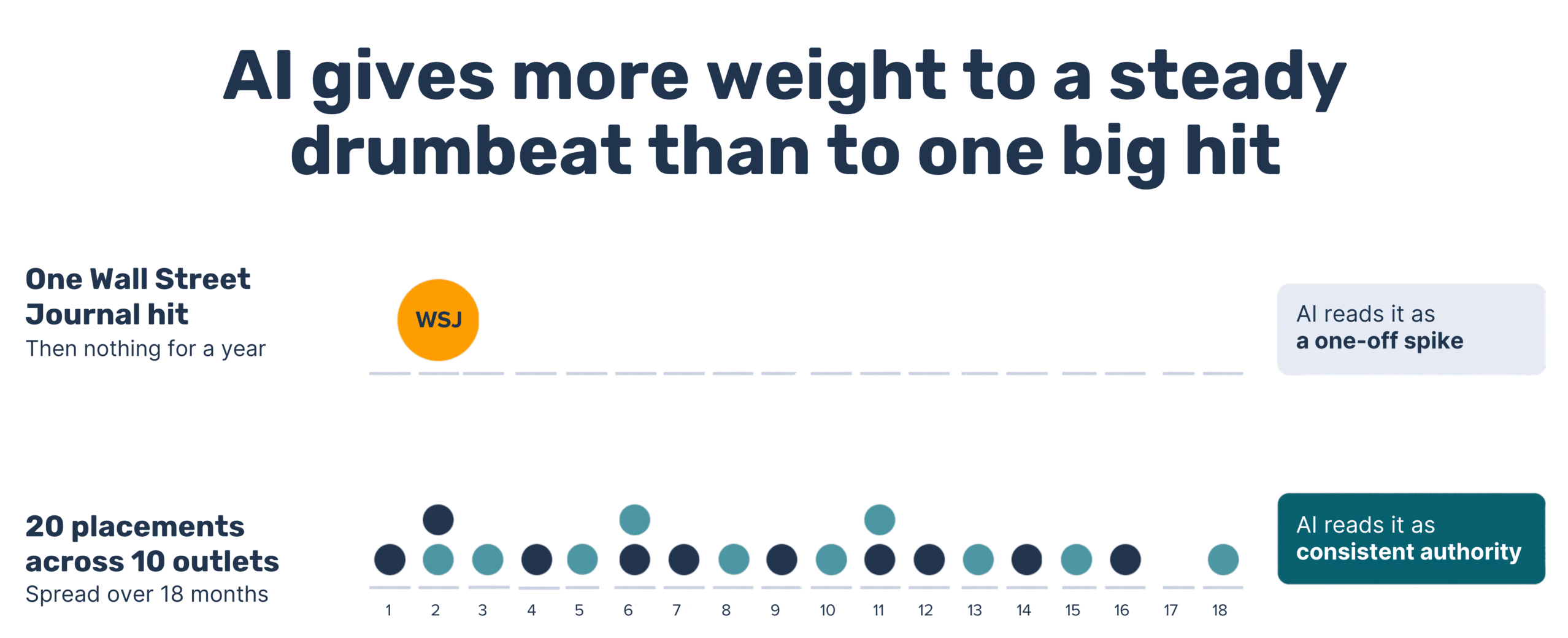
- Coverage is episodic. A coveted Journal profile of a brand is no small feat. But if it’s only a one-off placement, AI will merely see that as a coverage spike. What AI values more is consistency over time. Get 20 placements across 10 outlets over 18 months, and AI will elevate those to buyers. Don’t be afraid to tap syndicated media, either. Distributing to a wide range of publications can boost AI citations by as much as 325 percent.
- Coverage drifts from owned content. Every brand’s messaging shifts, especially in response to emerging industry trends. But any shift has to be consistent (noticing a theme?) across channels. When your brand’s positioning on your website differs from what’s in the media, AI will generally default to the version it trusts more. Sometimes, it may even mash together the two and show your buyers a Franken-brand of sorts. If you want accurate AI citations, it’s crucial to ensure you’ve aligned your earned and owned messaging.
When PR programs fall into these traps, AI citations suffer in quality. And in many cases, citations are already suffering: Nearly one in three AI answers are misattributions or outright fabrications.
These hallucinations affect every brand, but they pose the most serious threat to brands with thin or choppy earned coverage. Once AI detects a gap, it will do whatever it takes to close it. Your brand’s credibility just might be the price.
4 Ways to Adapt Your PR for GEO
If you’re already scrambling to pinpoint the gaps in your brand’s earned coverage, the good news is that you don’t have to let AI close them for you. These four steps can help you take control.
1. Map your outlet mix against AI citation patterns.
Research which AI models your buyers likely use. Then, identify which sources those models draw from when responding to prompts in your brand’s category. (LinkedIn, for instance, is the most-cited domain for professional queries across all AI platforms.) Our AI Overview Tracker (embedded below) is a helpful place to start. We also recommend taking a look at tools like Profound, Otterly, and Semrush Copilot. Once you’ve built a list of frequently surfaced outlets, prioritize them in your media strategy.
AI Overview Presence Over Time
All Intents
View as table
| Month | Top of Funnel | Middle of Funnel | Bottom of Funnel |
|---|---|---|---|
| Jul | 71% | 48% | 19% |
| Aug | 78% | 60% | 27% |
| Sep | 78% | 60% | 24% |
| Oct | 81% | 62% | 28% |
| Nov | 81% | 62% | 31% |
| Dec | 80% | 62% | 29% |
| Jan | 82% | 62% | 30% |
| Feb | 83% | 64% | 31% |
| March | 81% | 63% | 28% |
| April | 84% | 70% | 41% |
| May | 87% | 69% | 38% |
| June | 87% | 69% | 38% |
| July | 92% | 85% | 64% |
| Aug | 95% | 95% | 88% |
| Sept | 95% | 95% | 88% |
2. Treat bylines as citation infrastructure.
Your CIO’s byline in, say, Healthcare IT News on new patient data privacy trends is enormously valuable for AI citation building. Each new byline creates an asset that AI can easily retrieve and attribute. Over time, you’ll build topical authority in each model’s source pool. For the best results, push for a series of bylines across a topic area in publications you’ve built deep relationships with.
3. Brief analysts regularly and with specificity.
AI citations put a lot of weight on analyst mentions, whether via formal reports, briefings, or third-party roundups. You’re entering a new tier of credibility if your brand shows up in a Gartner Magic Quadrant, in a Forrester Wave, or on IDC MarketScape. These analysts provide independent evaluation that tells both AI and buyers you’re a brand to watch.
4. Use awards strategically as citation signals.
Awards make for great LinkedIn posts and press releases, but they also give AI another third-party data point about your brand’s best features. Put differently, AI treats award recognition as a credibility signal. This particularly matters for category and competitive queries (e.g., “What are the top 10 cybersecurity vendors for mid-market companies?” or “Compare these two vendors.”). In these scenarios, award data can help AI evaluate your brand’s strengths.
Crucially, you can implement these strategies without sacrificing your PR program’s bread and butter. In fact, with the steps we’ve suggested, the very things your program excels at will likely fuel your brand’s AI visibility, reputation, and awareness at the same time.
The Integration Piece PR Can’t Skip
The B2B communications world still has a lot to learn about how PR and GEO work together. One common principle, though, is that everyone loves a cohesive story. Including AI models. Your PR program will have more influence on AI visibility when there’s a clear through line from earned coverage to owned content to review platforms and community sources.
The inverse is also true. You’ll fragment the narrative through line when your press coverage contradicts website positioning. Or your G2 reviews tell a different story than analyst commentary. Or your LinkedIn presence undercuts your earned placements.
We can’t stress this enough: That kind of fragmentation will squelch any AI citation building strategy.
The most effective PR programs for AI visibility keep consistency front and center. Their messaging feels smooth and familiar everywhere the brand has a presence, whether that’s a trade press profile, a company blog post, or a LinkedIn article. As a result, AI can synthesize and surface a coherent narrative to buyers, no matter the query.
We’re not shy about praising the value of PR in any brand’s quest for AI visibility. Our research makes this clear. But to earn AI citations, PR programs have to do a lot more than keep the lights on” could become “PR for GEO takes more than keeping the lights on.
Robust AI visibility demands a strong foundation: a steady presence in AI-trusted outlets; cross-channel messaging alignment; and specific, authoritative coverage that AI can retrieve with confidence.
Next up in this series: how B2B communications leaders can make sense of social media’s role in AI visibility.
In the meantime, explore our AI Credibility Hub for more research on how AI is evaluating B2B brands.