


This page was drafted by some of PAN’s go-to media relations mavens, Ash Waters, Kirsten Welch, Jessica Tasman, Judy Lee, Sophie Tolsdorf.
Don’t want to read this full post? We get it. Life is short, and this page is long. Jump down to our FAQ section!
Table of Contents
- What Is Substack?
- The Shift Toward Independent Media
- What the Research Shows
- Substack for Businesses
- How Substack Compares to Other Newsletter Platforms
- How Substack Appears in AI Search and LLM Results
- The Role of New Media in Public Relations
- Making the Case for Substack to Your Leadership Team
- Top Substacks by Industry
- What Journalists in Traditional Beats Are Saying
- Where Substack Fits in a Full Earned Media Strategy
What Is Substack?
Substack is a subscription publishing platform where writers earn directly from their readers — but that explanation misses what the platform has become. What is Substack for, practically speaking? An ecosystem of credentialed journalists, analysts, and operators who left traditional newsrooms to publish directly to professional audiences. Former reporters from The Wall Street Journal, Bloomberg, and Fortune. Enterprise technology editors with decades of sourcing relationships. Fintech analysts who know their industries from the inside. These writers took their expertise with them when they left, and in many cases, their audiences followed.
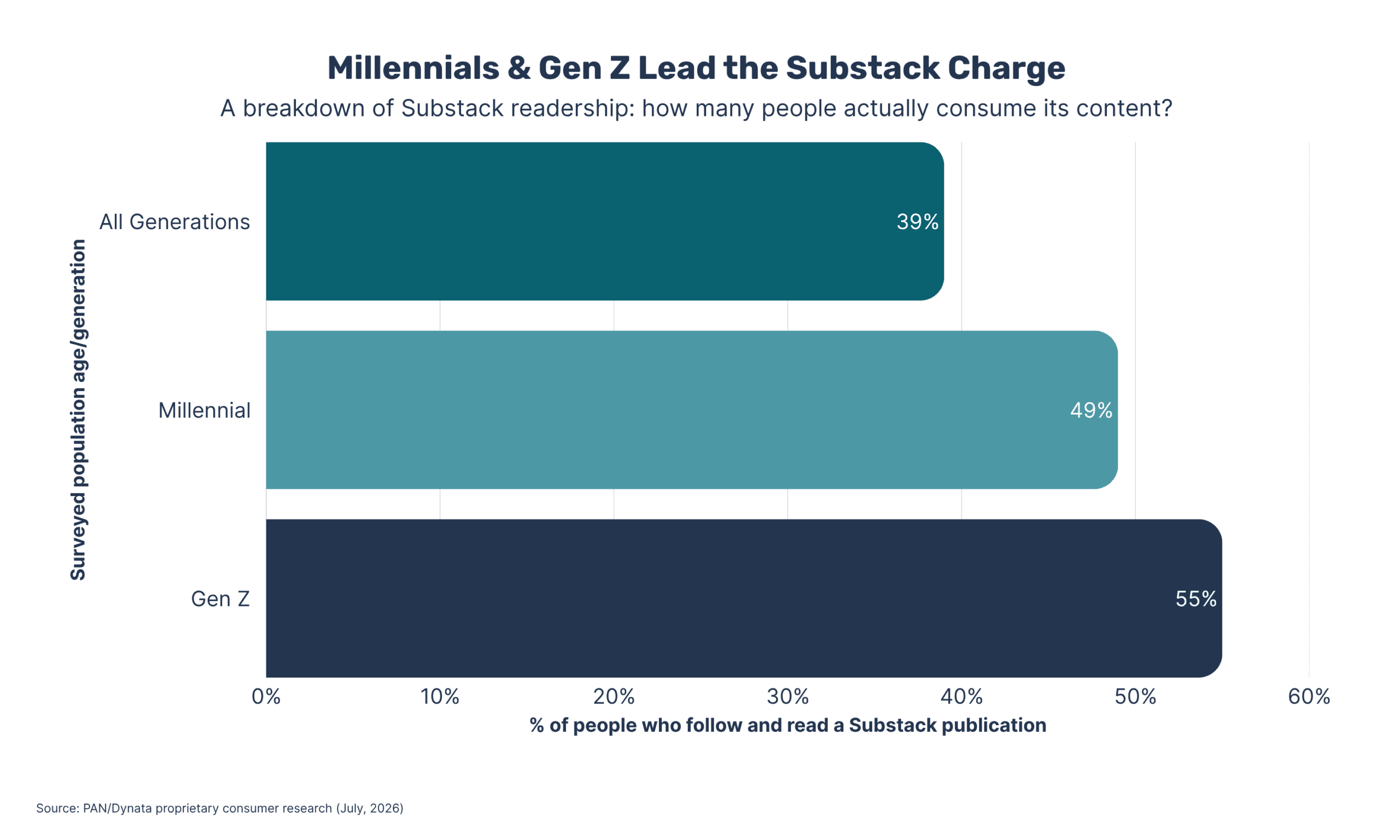
We conducted proprietary consumer research with Dynata to measure the platform’s actual footprint. The findings: 39 percent of consumers regularly read at least one Substack publication, rising to 55 percent among Gen Z and 49 percent among Millennials. Seventeen percent have paid for a newsletter subscription. Eighteen percent say their usage has grown over the past year. These readers are self-selected subscribers who opted in specifically because they trust a particular writer’s perspective — a fundamentally different relationship than a general-interest audience.
The Shift Toward Independent Media
Why journalists left and what they took with them
The structural case for independent publishing developed over years. Advertising-supported media contracted. Editorial teams shrank. Beat reporters who had spent decades building expertise found that their credibility traveled with them when they left — and platforms like Substack made it financially viable to go.
What moved with these writers was something mastheads could never own: audience trust. A reporter who covered enterprise software for a decade carries that expertise into every newsletter she publishes, often with more editorial latitude than she had inside a traditional newsroom. A Substack with 8,000 deeply engaged fintech subscribers can reach more concentrated decision-maker audiences than a business outlet with a hundred times the traffic. The publication logo matters less than the writer’s specific credibility within a professional community.
Substack takes 10 percent of paid subscription revenue, with payment processing fees layered on top. Publishing is free. That revenue structure aligns writer incentives with reader trust rather than traffic volume, which partly explains why engagement metrics on the platform tend to run higher than on ad-supported media. The future of media is taking shape around this dynamic — and according to our own reporting from industry events, Substack captured more traffic than The Wall Street Journal and CBS News combined in a recent month, which signals just how fast the audience migration is moving.
Related Read >> Non-Traditional Media Is Booming: Are You Speaking Where Your Audience Is Listening?
What the Research Shows: PAN Data on Substack Readership
Business and technology rank among the top content categories on the platform. News and politics leads at 21 percent, followed by technology at 18 percent, health and wellness at 17 percent, and food, travel, and lifestyle at 17 percent.
For most readers, Substack supplements rather than displaces existing media habits. Thirteen percent say it complements traditional news sources, and 11 percent use it alongside social media. This framing matters for internal conversations: Substack is reaching professional audiences in addition to mainstream coverage. It’s additive.
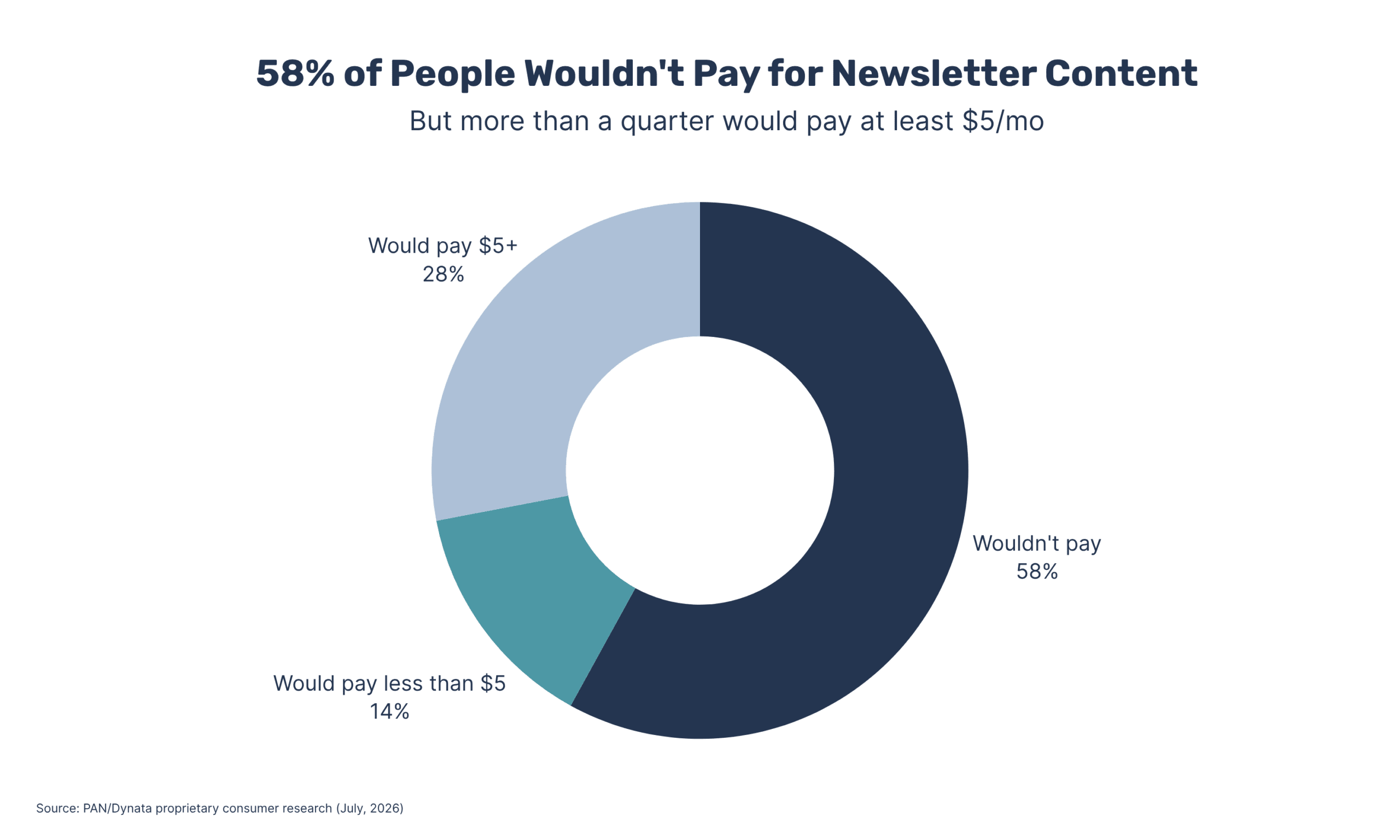
The monetization picture reflects a platform in early maturity. Most consumers — 58 percent — say they wouldn’t pay for a newsletter subscription. But 42 percent would, and 28 percent say they would pay more than $5 a month. The paid subscriber segment is the most engaged, most loyal audience on the platform. The most influential industry publications tend to structure access around it, which tells you something about the quality of the readers behind a paywall, even when subscriber counts are modest.

Substack for Businesses: How Companies Can Use Independent Media Strategically
Substack for businesses starts with placing the platform correctly within a broader earned media program. The goal is to extend the footprint of an earned strategy into channels where target audiences actually spend attention — as a complement to traditional media relations, not a replacement for it.
The most direct application is earned outreach to independent writers who cover your company’s industry. Many of the most influential publications in fintech, enterprise technology, SaaS, and HR are run by writers who actively seek executive commentary, original research, and practitioner perspectives. Because they control their editorial direction entirely, they can pursue longer-form angles, in-depth interviews, and collaborative commentary that traditional newsrooms rarely have room for.
Substack’s growing role in AI-powered search adds another layer of strategic value. Public posts are crawlable and indexable, and AI systems evaluating topical authority can surface them in relevant queries. A mention from a respected industry Substack contributes to the body of expert commentary around a brand, influencing how AI tools understand a company’s positioning over time. For communications teams building toward AI citation visibility, placements in ungated, consistently-published newsletters are a meaningful part of the full content footprint.
Brands building owned thought leadership channels can also use Substack as a publishing platform for long-form executive content and research distribution. A company newsletter that professionals actively subscribed to produces different engagement signals than a gated asset behind a form. Paid Substack sponsorships — used selectively — can complement earned efforts by reaching self-selected professional audiences that standard advertising rarely delivers with comparable precision.
How Substack Compares to Other Newsletter Platforms
Substack operates in a broader ecosystem of independent publishing tools. beehiiv and Ghost have both grown as alternatives, each taking a different approach.
| Platform | What It Is | Primary Strength | Weakness | PR Value |
|---|---|---|---|---|
| Substack | Subscription publishing platform with a built-in discovery ecosystem | Established ecosystem of journalists, analysts, economists, and industry experts who built audiences after leaving institutional media | Editorial standards vary widely; anyone can publish | Highest media relations value — many influential reporters and former newsroom journalists have built meaningful audiences here |
| beehiiv | Newsletter platform focused on audience growth and monetization | Sophisticated marketing, analytics, and referral tools | Less of a journalism ecosystem; more creator- and business-focused | Moderate PR value. Better viewed as a publishing platform than a media ecosystem |
| Ghost | Open-source CMS with integrated newsletters and memberships | Complete ownership, customization, and SEO control | No native discovery or audience network | Low direct PR value as a media target, but strong for brands building their own thought leadership hub |
For enterprise communications programs, the platform matters less than who is publishing on it. Substack has the strongest concentration of journalists and analysts who carried institutional-media credibility into independent publishing. Ghost and beehiiv are better understood as publishing infrastructure — relevant for brands building owned channels, but not media destinations in the same way Substack has become.
Related Read >> The New Definition of “Top-Tier” Media
How Substack Appears in AI Search and LLM Results
Substack’s role in AI discoverability is still developing, but it’s already relevant to earned media strategy. Public Substack posts can be indexed by search engines and can surface in AI-powered results, depending on whether the author has established topical authority and whether the content is structured around coherent, specific expertise.
Publications with consistent editorial focus, recurring analysis, and identifiable writer credentials tend to perform better in systems that rely on entity-based authority signals. The distribution model matters alongside placement quality: paywalled content is less accessible to AI tools, which means an ungated placement carries additional value in the AI search context.
Substack launched AI detection tools in 2025 that estimate how much content is human-written versus AI-assisted, with transparency signals visible to subscribers. That development has direct implications for pitch strategy. Independent writers are increasingly prioritizing authentic, human-authored perspective, which means pitches leading with genuine executive expertise will outperform AI-generated commentary both in pitching conversations and within the platform’s discovery ecosystem.
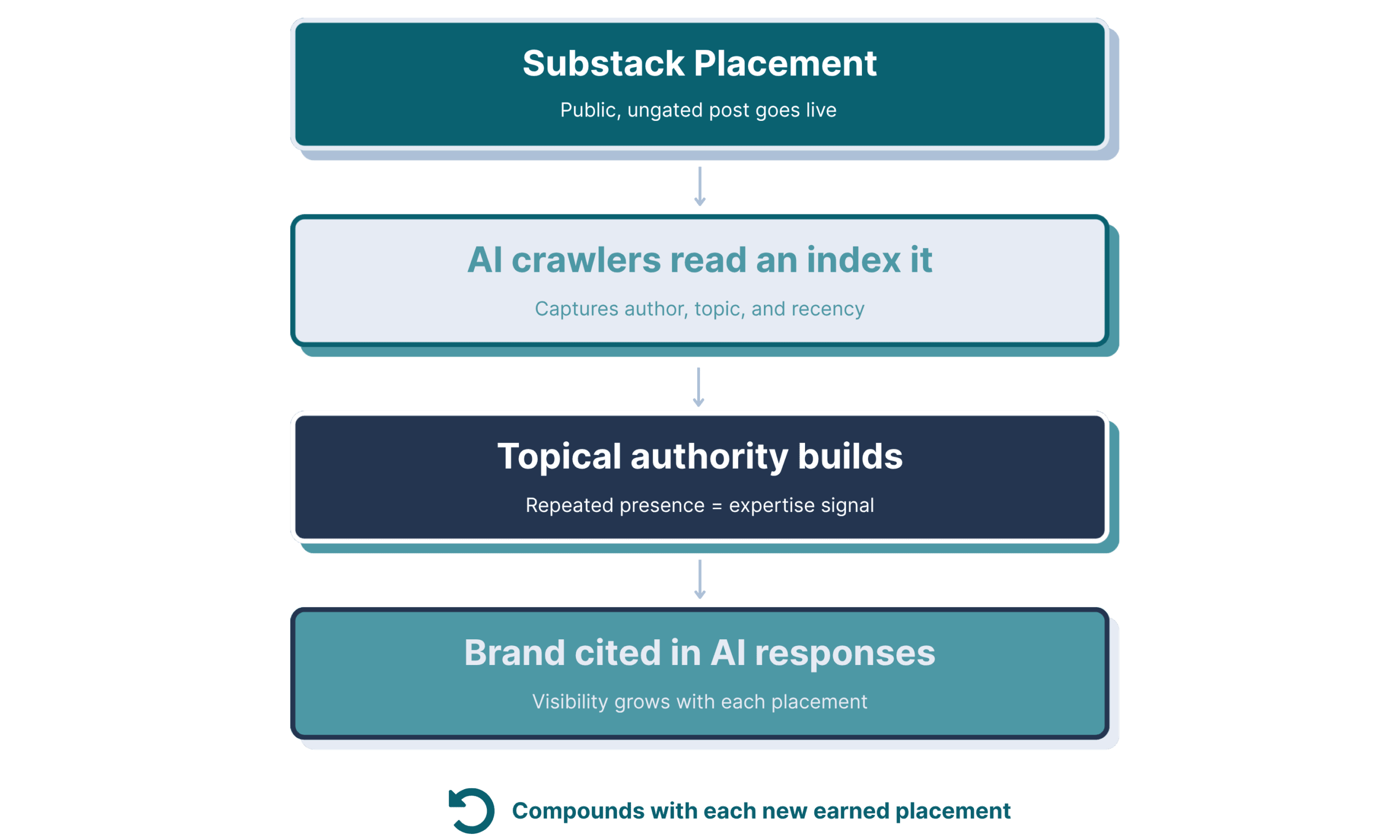
For communications teams with AI visibility goals, our research on what actually drives AI citation shows that no single channel produces visibility on its own — the typical brand that AI surfaces will consistently have presence across earned media, owned content, and third-party sources. Substack placements in well-established, ungated publications are a meaningful part of building that full footprint. Don’t believe what we’re saying? Maybe the flowchart below will convince you!
The Role of New Media in Public Relations
Rethinking the media list for an independent media era
The role of new media in public relations is a distribution problem at its core. Professional audiences aren’t consuming information from the same sources they relied on a decade ago. The writers and analysts they trust most may be publishing independently on Substack, building community on LinkedIn, or producing audio through podcast networks that didn’t exist when most media lists were built. A PR program structured exclusively around traditional outlets is miscalibrated for where influential professional audiences actually spend their attention.
Substack’s independence makes evaluation harder than traditional media, which requires more deliberate research before pitching. Most publications don’t issue media kits. Subscriber counts are rarely public. Editorial models vary considerably — some Substacks operate like miniature newsrooms with defined beats and standards; others are the recurring perspective of one expert who publishes when something genuinely warrants commentary. Both formats serve PR programs; they require different approaches.
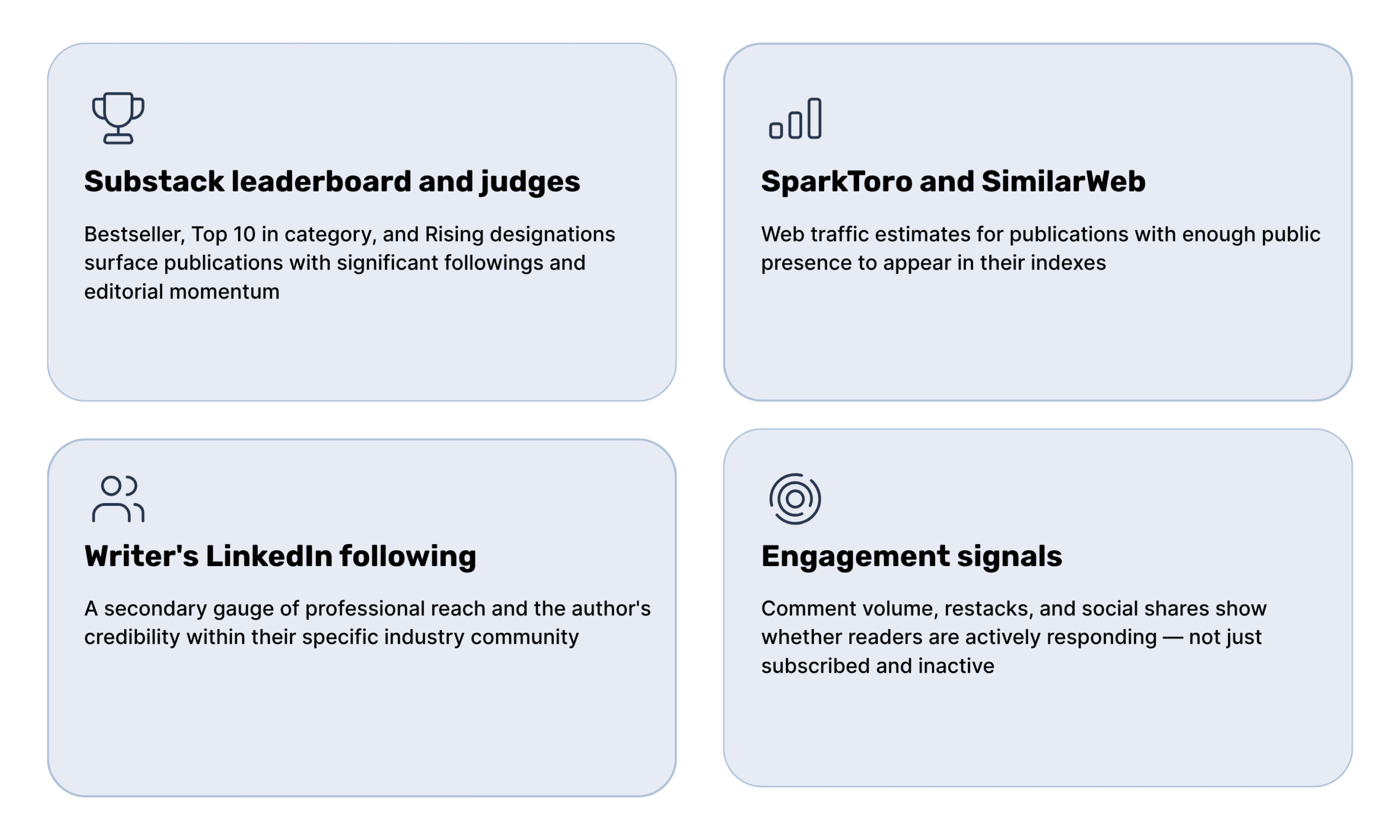
Several signals help assess a Substack’s reach and relevance when subscriber data isn’t available:
- Substack leaderboard rankings and badges
- SparkToro and SimilarWeb
- The writer’s LinkedIn following
- Engagement signals
Pitching Substack writers
The most consequential mistake PR teams make with Substack outreach is treating independent writers like standard media contacts. Many of them left institutional newsrooms specifically for editorial autonomy and closer relationships with their audiences. A pitch formatted for a mass send will signal exactly the wrong things about how seriously you’ve read their work.
Substack’s in-platform messaging carries specific risk. Writers can flag messages as spam, which can restrict account access and limit future outreach. The safer approach is confirming via LinkedIn or email that a writer accepts pitches before sending a full pitch through the platform. In some cases, replying to a newsletter edition — demonstrating genuine familiarity with recent issues — is a more credible entry point than any cold message.
What tends to work: referencing specific recent issues by topic, offering executive access or proprietary data the writer couldn’t easily source independently, and pitching angles tied to the publication’s coverage areas. Many independent writers are more interested in trend analysis and implications than product launches or funding announcements. Lead with insight. For a detailed look at what journalists themselves say they want from PR, see our conversations with Shaun Sutner at AI Business and Jennifer Bresnick at Digital Health Insights.
Related Read >> How to Leverage Substack to Gain Real Traction with PR Campaigns
Making the Case for Substack to Your Leadership Team
Getting Substack added to an earned media program often requires an internal sell before anything else. CMOs, VPs of Communications, and revenue leaders are accustomed to evaluating earned media by brand recognition — a masthead name they know and can point to in a board update. The arguments below are designed for that conversation. They reframe the metrics that matter and give comms teams language to position Substack placements alongside, not below, coverage in traditional outlets.
Evaluate influence over brand recognition
A recognizable outlet name isn’t always the most accurate measure of business impact. A respected independent writer with a highly engaged professional audience can drive more meaningful decision-maker conversations than a larger general-interest publication. For most B2B communications goals, audience concentration and professional relevance matter more than total reach or masthead prestige. When briefing leadership, lead with who the audience is — not how big the publication is.
Treat leading Substacks like trade publications
Many of the most influential Substacks deserve the same evaluation criteria applied to traditional trades: editorial quality, subject-matter expertise, audience relevance, consistency, and influence within a specific vertical. The platform is different; the framework doesn’t have to be. Framing Substack placements using language leadership already understands — “this is the go-to newsletter for fintech CFOs” or “the editors here cover the same beat as The Wall Street Journal Tech desk, but for enterprise practitioners” — makes the case without requiring anyone to learn a new mental model.
Define earned media broadly
Independent newsletters complement traditional media relations as part of a diversified thought leadership program. They reach professional audiences that mainstream coverage frequently misses, through channels those audiences have actively chosen. When making the case to leadership, position Substack outreach as audience extension — a way to reach the exact practitioners, decision-makers, and industry insiders who already trust the writers covering their world.
Related Read >> Non-Traditional Media Is Booming: Are You Speaking Where Your Audience Is Listening?
Consider the multiplier effect
Many influential Substack writers also contribute to major publications, speak at industry events, appear on podcasts, and maintain significant LinkedIn presence. A relationship with an independent writer often generates opportunities well beyond any individual newsletter placement — including potential citations in mainstream media coverage and AI-generated responses to relevant queries. Social proof built through multiple touchpoints compounds in ways a single placement can’t match. This is especially worth emphasizing when leadership asks whether Substack placements “count” alongside more traditional coverage.
Measure outcomes…logos should take a backseat
Success from Substack placements shows up in executive engagement, inbound inquiries, social discussion, newsletter shares, and citations by mainstream media — not just impressions or circulation figures. When reporting on Substack activity to leadership, frame results around evidence of audience engagement and downstream business signals rather than reach alone. Our guidance on PR measurement covers how to build a reporting framework that accounts for these kinds of qualitative and quantitative signals together.
Top Substacks by Industry
The publications listed below represent our curated recommendations across core practice areas. Selection criteria include editorial quality, writer credentials, audience concentration, and demonstrated relevance to B2B communications programs. Subscriber count alone was not the determining factor.
Business Substacks
While more broadly popular business Substacks exist, the publications below have been selected for fit with B2B communications needs. And don’t worry, reader, we’re going to keep updating this list!
The Generalist — Mario Gabriele | 167,000 subscribers
Covers technology, venture capital, AI, and company strategy, with a reputation for exceptionally deep company analyses, founder interviews, and long-form reporting aimed at investors, founders, and senior operators. The core readership includes C-suite leaders at public technology companies, venture capital partners, and senior operators — it is heavily investor-focused. Best fit for enterprise tech, cybersecurity, fintech, healthcare tech, supply chain tech, and VC-backed technology companies. Gabriele frequently interviews founders and CEOs, and the publication accepts sponsorships and brand partnership opportunities. Avoid pitching product launches, funding announcements, or marketing-heavy messaging. The Generalist’s work has been cited by the Financial Times, The Wall Street Journal, Bloomberg, and TechCrunch.
Lenny’s Newsletter — Lenny Rachitsky | 1.2 million subscribers
Founded by former Airbnb product leader Lenny Rachitsky, this is one of the largest business publications on Substack, with a focus on deeply researched, practical guidance for product leaders, founders, and technology executives. Topic coverage includes product management, growth strategy, AI, go-to-market execution, leadership, and career development. Best fit for enterprise software, AI, SaaS, customer experience, and marketing technology. Rachitsky is selective about sources — he prioritizes those with proven expertise, recognizable business outcomes, and actionable lessons. He favors “how I built or shipped X” stories told by credible product or engineering leaders, and he frequently features paid guest posts. His companion podcast, Lenny’s Podcast, has 619,000 YouTube subscribers.
workwire — Tony Case | Growing (launched January 2026)
A newer newsletter from workplace journalist Tony Case, former WorkLife senior reporter and Adweek executive editor. Examines work and how organizations can make it better, covering workplace culture, employee experience, HR, leadership, management, careers, and workforce trends. Best fit for HR technology, employee recognition and engagement, workforce management, collaboration technology, and AI at work. Case often sources through Qwoted. We success to date: the Edgebeam team pitched an angle on clarity in leadership paired with Dynata data, which led to a CEO interview and a lead story in that edition.
The Fintercept — Brendan Ragan | ~2,000 subscribers (July 2026)
A fintech-focused Substack that examines what developments mean and what may happen next, rather than recapping news. Common topics include payments, banking technology, financial infrastructure, embedded finance, regulation, fintech strategy, and industry competition. Very source-friendly — the publication’s model is built around perspectives from fintech C-suite executives. Best fit for fintech, banking and payments technology, fraud prevention, identity, cybersecurity, data infrastructure, and financial-services software. Accepts sponsorships. Often sources through Qwoted. We success to date: the Nuvei team responded to a Qwoted request, which resulted in coverage and established an ongoing relationship with the founder.
Mostly Metrics — CJ Gustafson | 75,000 subscribers
Created by technology CFO CJ Gustafson, designed for current and aspiring CFOs, particularly those at startups and technology companies. Coverage includes SaaS metrics, annual planning, pricing, fundraising, capital markets, go-to-market strategy, finance technology, board reporting, and M&A. The strongest pitches would offer an experienced CFO, distinctive financial benchmarks, or a practical perspective on how companies measure performance. Gustafson hosts the Run the Numbers podcast, with 11,300 YouTube subscribers. Most content is free; paid subscriber content and sponsorships are also available.
The Retail Pulse Report — Nikki Baird | Several hundred subscribers
Written by retail technology strategist Nikki Baird, covering retail and technology strategy on a weekly basis. Topics include retail technology, AI and agentic commerce, consumer behavior, ecommerce, retail economics, digital strategy, and personalization. The most useful source offerings would include proprietary consumer data, retailer benchmarks, clear evidence of technology ROI, or access to senior retail practitioners. She favors a heavily targeted, relationship-driven approach to working with PR — a generic pitch won’t land.
FullStack HR — Johannes Sundlo | 11,000 subscribers
Covers developments in HR, leadership, and the future of work, including HR transformation, AI adoption, performance management, employee experience, and organizational change. Sundlo favors practitioners and external research; the strongest pitches provide practical lessons, credible workforce data, or executives who can speak candidly about implementing change. All content is public. Sundlo has a YouTube channel with over 5,000 subscribers.
Technology Substacks
While more broadly popular technology Substacks exist, the publications below have been selected for fit with B2B communications needs. Please read each description carefully before pitching.
The Stack / Runtime — Tom Krazit | 20,000+ enterprise technology professionals
The Stack serves exclusive interviews, insight, and intelligence to digital leaders globally, with readership that includes 75 percent of CIOs in the Fortune 500. In June 2026, The Stack acquired U.S. enterprise tech Substack Runtime, with Runtime’s Tom Krazit becoming Editor in Chief. Subscribers now receive “Runtime, from The Stack” three times weekly. Krazit’s audience is enterprise technologists, so sources must offer insight about how systems actually work — not just strategy. He favors engineering leaders, infrastructure operators, and product builders, and leans on in-depth interviews and roundtables, often with repeat sources. Establishing a strong relationship over time is more effective than one-off pitches.
Latent.Space — Shawn “swyx” Wang and Alessio Fanelli | 200,000+ across channels
A technical newsletter, podcast, and community for AI engineers, covering the business and technology of the current AI cycle. The publication has crossed 10 million viewers across all channels. Core guests and sources typically include AI researchers at labs like OpenAI, Anthropic, and Meta; founders of AI infrastructure startups; ML engineers building tooling; and venture investors specializing in AI infrastructure. The team picks most sources from networks they already know, which means subject-matter experts should engage with them on social media and community platforms before a formal pitch. The publication takes contributed content.
Ground Level AI — Sharon Goldman | Founded 2026
An independent media platform dedicated to reporting on what AI is actually doing to the world — covering digital and physical infrastructure, enterprise AI deployment, security and governance, policy and geopolitics, and workforce implications. Goldman previously covered AI for Fortune and VentureBeat. She interviews AI researchers at established companies and startups doing impactful work. She does not take embargoed news. She also hosts a podcast of the same name. Some articles are free; full access requires a paid subscription.
Platformer — Casey Newton | 200,000+ subscribers
Founded in 2020 by former The Verge editor Casey Newton, Platformer covers the intersection of technology platforms and society, with reporting on AI and its consequences, tech politics, antitrust and the law, and the fracturing social web. Newton talks to the major tech players — Microsoft, Google, Meta — as well as smaller AI startups, researchers, and economists. He welcomes story tips, alternate perspectives, relevant academic papers, and commentary from the research and policy communities.
Big Technology — Alex Kantrowitz | 152,000+ subscribers
One of the most influential AI and business newsletters on Substack, covering the major technology companies and their impact on society. Uncovers behind-the-scenes business models, industry systems, and trends shaping the technology news cycle. Kantrowitz frequently interviews CEOs, founders, and executives from major AI companies, as well as analysts and academics. He also speaks with former big tech executives — useful for companies whose subject-matter experts have prior experience at major technology companies. He does not take embargoed news and values informed perspective over corporate messaging.
SaaStr AI — Jason Lemkin | Community hub
The world’s largest community for B2B founders, executives, and investors, operating across a blog, podcast, live events, and workshops with a heavy recent focus on AI’s effect on SaaS. Lemkin talks primarily to SaaS founders, operators, and VCs. Not a strong target for news placement, but well suited to executive interviews on market conditions and AI’s implications for the SaaS landscape.
The Pragmatic Engineer — Gergely Orosz | 1.1 million subscribers
The number one software and AI engineering newsletter on Substack, highly relevant for software engineers and engineering decision-makers. Orosz covers how companies actually build software, tech workplace trends, and AI’s effects on engineering and tooling. He talks primarily to practitioners — engineers and engineering leaders at name-brand companies speaking about their own work and experience, not company spokespeople commenting on trends. He publishes paid guest posts from writers with deep, specific expertise. Not a strong target for news placement, but well suited to practitioner interviews or paid contributions on technical subjects.
Decoding Customer Experience (DCX) — Mark Levy | 1,500+ subscribers
A newsletter focused on practical, tactical CX strategy, written by former Comcast VP of Digital Experiences Mark Levy. Coverage centers on simplifying decision-making for CX leaders and connecting insights to action through real-world examples and stories. Levy draws on third-party research and his own operator experience rather than named interview subjects, but he does cover company news and case studies. We success to date: after the team identified DCX as a valuable relationship to build, they connected with Levy through LinkedIn, shared specific thoughts on his work, and maintained the relationship over time — eventually securing coverage of a major PolyAI announcement.
Two honorable mentions
Upstarts Media — Alex Konrad: Covers startup news. Konrad carries significant credibility, but the publication’s focus is not a strong fit for most B2B communications programs.
Kevin Roose Substack — Kevin Roose is a New York Times technology columnist who is leaving the paper to start a new media company with Casey Newton. Details are still developing, but the venture will include a video podcast on AI based in San Francisco. Worth monitoring as the launch materializes.
What Journalists in Traditional Beats Are Saying
Substack isn’t the only part of the media landscape that’s changed. Across established publications, journalists are covering similar beats with increasingly specific expectations about what makes a pitch worth their time. Understanding those expectations — before you pitch — is the difference between an inbox delete and a genuine editorial conversation. Our PAN Press Pass series documents direct conversations with journalists about what they cover, what they actually want from PR teams, and how AI and audience fragmentation are reshaping their work.
The conversations below are worth reviewing before building a media list in any of these verticals. The patterns that emerge — lead with substance, bring customer proof, know the publication before you pitch — hold across Substack writers and staff reporters alike.
AI and healthcare
Jennifer Bresnick, Founder at Inkless Creative Services and Senior Contributor at Digital Health Insights: Bresnick covers healthcare systems, policy, and technology, and she’s explicit about what she wants from sources: thought leadership with real insight, not just thoughts. Her most-cited frustration is sources who talk about problems without offering specific, actionable guidance. She looks for subject-matter experts willing to be “unflinchingly honest” about gaps in how things are done and what others in similar positions should do differently. Sources working in industry collaborations or professional societies are particularly valuable to her because they can speak from both individual and peer perspectives.
Shaun Sutner, Senior News Director at AI Business: AI Business covers companies that build AI, not those who merely apply it — a distinction that disqualifies many enterprise software companies from their coverage scope. Sutner wants substance over hype, particularly when it comes to partnership announcements, which he scrutinizes closely for whether anything genuinely new is happening. Customer validation is the single most important element he looks for. Generic blast emails are one of his most-cited frustrations.
Enterprise technology
Carl Franzen, Executive Editor at VentureBeat: VentureBeat targets enterprise technical decision-makers — CTOs and the people responsible for technology execution, not just the CEO. Franzen wants a clear answer to one question before he covers anything: “Is this something another business could use to help grow, make more efficient, or introduce a new capability?” Customer stories and in-practice examples are more compelling than vendor claims. Embargo windows for smaller vendors should open at least a week in advance; major vendors can sometimes work with 24 to 48 hours.
Isaac Sacolick, StarCIO President and CIO / InfoWorld Contributor: A former CIO and CTO who now writes for publications including CIO and InfoWorld, Sacolick filters everything through the lens of what matters to leaders responsible for budgets, teams, and strategic direction. He reviews hundreds of contributed quotes per quarter and is direct about what earns inclusion: quotes that teach him something new, grounded in real expertise, that move the narrative forward. Generic observations and promotional language don’t make the cut.
Customer experience and workplace
Dom Nicastro, Editor-in-Chief at CMSWire: CMSWire’s editorial focus is customer experience and digital experience. Nicastro values practitioner perspectives over vendor promotion — he’d rather interview a customer of a technology provider than the executive, and he’s candid that he likely won’t mention the vendor unless it’s unavoidable. He encourages comms teams to amplify practitioner interviews on owned channels to establish their connection to the story. His advice on pitching is also worth noting: pitching news a week after a press release is too late for a publication that competes on organic search traffic.
Emma Burleigh, Reporter at Fortune: Burleigh covers success, careers, and the evolving workplace. Her sourcing has shifted — previously weighted heavily toward executives, it now runs closer to half executives and half workers, which means pitches anchored entirely in C-suite perspective may miss opportunities. She is consistently looking for hard data: sales numbers, revenue, valuation, and other financial markers should be standard in any pitch. Generational angles and stories about how AI is actually affecting jobs perform particularly well with her readers.
Business and entrepreneurship
Jennifer Conrad, Senior Writer at Inc.: Conrad covers American entrepreneurship and fast-growing companies for Inc. Financial transparency is non-negotiable — she needs revenue, growth, and profitability data to make a business story work for her readers. The strongest pitches present a challenge with a solution: a narrative arc that gives other entrepreneurs something to learn from. B2B pitches work best when they include a customer case study with honest details about what went wrong and how it was resolved, not just the success story.
Where Substack Fits in a Full Earned Media Strategy
Substack is part of a larger shift in how professional audiences consume information — a shift that has moved influence away from mastheads and toward specific, credible voices that readers have actively chosen to follow. For communications teams, that shift has real strategic implications. A media list that only includes traditional outlets misses where a meaningful share of decision-maker attention is already going. A Substack strategy that treats newsletters as a quick alternative to traditional media relations misses the relationship-first approach that makes independent writers worth pitching at all.
What the research and the platform’s trajectory suggest is that Substack works best as part of a coherent content footprint rather than a standalone tactic. A brand that earns consistent placement in respected industry newsletters, while maintaining strong owned content and traditional media coverage, builds the kind of signal that AI tools draw on when they’re deciding which companies to surface in relevant queries. Our research on AI visibility makes the mechanics of this explicit: the brands AI surfaces most consistently are the ones with coherent presence across earned media, owned content, and third-party sources — not the ones who optimized any single channel.
The journalists in the PAN Press Pass series reinforce the same conclusion from a different angle. Whether they’re writing for VentureBeat, CMSWire, or an independent Substack, they want the same things from the communications professionals who reach out: specificity, substance, and genuine familiarity with what they cover. The tactics vary by publication. The underlying requirement doesn’t.
For communications teams evaluating where Substack fits, the answer is the same place it’s always been for any earned media channel: among other credible, relevant, relationship-driven efforts that put audience trust ahead of placement volume. The publications in this guide are worth pursuing because their readers match the audiences that matter — not because Substack is new. The definition of what makes a placement valuable has always been about that. The platforms have just changed.
Quick Answers About Substack for a B2B Audience
Substack is a subscription publishing platform where credentialed journalists, analysts, and industry experts publish directly to professional audiences. For B2B PR teams, it represents a growing ecosystem of influential writers who left traditional newsrooms and took their expertise and audience trust with them.
News and politics leads at 21 percent, followed by technology at 18 percent, with health and wellness and food, travel, and lifestyle each accounting for 17 percent. For B2B communications teams, the technology figure is the more relevant signal: the practitioners, buyers, and decision-makers most likely to influence enterprise purchasing decisions are reading vertical-specific newsletters at meaningful scale, and that readership is concentrated rather than passive.
Less than most people assume. A newsletter with 2,000 fintech CFO subscribers who regularly comment, restack, and respond to the writer carries more communications value for the right client than a general-business newsletter with ten times the list. Engagement signals — comments, restacks, social shares on recent posts — tell you far more about whether an audience is actually paying attention than a subscriber number that may include thousands of dormant free-tier readers.
Substack launched AI detection tools in 2025 that estimate how much of a newsletter’s content is human-written versus AI-assisted, with signals visible to subscribers. The implication for PR teams is direct: independent writers are increasingly skeptical of AI-generated pitches, and a pitch that reads as templated or machine-generated is more likely to damage a relationship than a well-crafted pitch that arrives a week later. Specificity — referencing a recent issue, offering data the writer can’t easily find elsewhere, connecting to their actual coverage areas — remains the most reliable differentiator.
With more than 350+ years of experience across the leadership bench, dozens of individual awards, and countless launched careers — this is a team that knows your business like no business. The people doing the work on your account belong to two groups: the next generation of PR and marketing leaders and the current ones.
Technology, fintech, HR and workforce, customer experience, and healthcare have the deepest concentrations of credentialed, professionally connected Substack writers. These verticals have enough independent newsletters run by former institutional journalists and industry practitioners that a targeted media list is genuinely feasible. Coverage is thinner in more regulated or traditionally consolidated industries, though the landscape is expanding as the independent publishing model continues to mature.
That’s all us. We’re the experts.
Yes! Our research found that 42 percent of people would pay, monthly, for the right newsletter. The 58 percent who say they wouldn’t pay are largely the free-tier audience (i.e., they’re not as engaged). Publications that have built paid subscriber bases tend to have the most loyal, most responsive readerships, which makes raw subscriber counts an unreliable proxy for a newsletter’s actual influence.
Substack works best as a complement to traditional media relations, not a replacement for it. It extends a brand’s earned media footprint into channels where professional audiences are already spending attention, and placements in well-established, ungated publications also contribute to AI search visibility.
Public Substack posts are crawlable and indexable, and AI systems can surface them in relevant queries when a writer has established topical authority. Ungated placements carry additional value because paywalled content is less accessible to AI tools evaluating a brand’s content footprint.
Substack has the strongest concentration of journalists and analysts who carried institutional-media credibility into independent publishing, making it the most valuable platform for media relations. beehiiv and Ghost are better understood as publishing infrastructure suited for brands building owned channels rather than media destinations in the same way Substack has become.
Frame Substack placements around audience concentration and professional relevance rather than masthead recognition, and treat leading newsletters the way you would a respected trade publication. Success shows up in executive engagement, inbound inquiries, social discussion, and downstream media citations, not just impressions or circulation figures.