

The B2B buyer journey is changing faster than most marketing teams can rewrite their strategy decks. (Not us, though, we’re on top of it.)
Executives are increasingly using traditional search less and less. They’re now turning to generative AI platforms, specialized forums, social channels, and trusted publications that vary widely by role. That shift has clear implications for PR, content, and brand visibility. But that’s not news to you. The shift has been top of mind for practitioners and pundits alike for the better part of three years.
Still, the importance remains, especially for teams trying to reach c-suite executives when each persona is navigating a different digital ecosystem.
Across nearly every major 2025 buyer study, one trend remains consistent: Executives are incorporating AI into every stage of the research and evaluation process. According to eMarketer, 47 percent of B2B buyers use AI for market research and discovery, and 80 percent of tech buyers use generative AI as often as traditional search. Responsive reports that nearly two-thirds of buyers use GenAI as much as or more than search, while G2 finds that 50 percent of decision-makers start with ChatGPT more often than Google.
The percentages may vary, but the direction is unmistakable. AI is a core component of vendor discovery, shaping when, where, and how executives encounter your brand.
And our C-Suite Signals research confirms the next critical layer: Each executive sees something different. Their discovery pathways (links, publications, domains, social sources, and queries) meaningfully diverge by role. In other words, there is no single executive buyer journey anymore. There are multiple, persona-specific ecosystems you must intentionally design for.
This post unpacks how that shift is unfolding, what marketers need to pay attention to, and how to shape a cross-channel strategy that aligns with the way executives actually search, learn, and decide today.
The GenAI Effect: Why Every B2B Buyer Now Starts Somewhere Different
Generative AI has become a research companion, a shortcut to initial understanding, and a filter that determines which brands appear — and which never surface at all. AI’s rapid adoption stands out across industry reports:
- Eighty-nine percent of B2B buyers have adopted GenAI, according to Forrester.
- MarTech reports that 94 percent of AI users find it helpful in evaluating vendors.
- Responsive finds that nearly one-quarter of buyers use GenAI more than search when evaluating vendors.
This widespread adoption doesn’t replace the traditional B2B buyer behavior we’ve studied for years. But it does modify it. Instead of a linear journey (problem → search → shortlist → evaluation → decision), buyers move fluidly across:
- AI platforms
- Analyst sites
- Industry media
- Social channels
- Online communities
- Company-owned content
- Peer-driven sources like review platforms
That multichannel movement is also fragmented at the c-suite level. Because executives’ responsibilities differ, their information diets are shaped by different triggers: operational risk, financial stability, security threats, regulatory pressure, efficiency gains, or patient outcomes.
And that’s where persona-specific visibility becomes essential.
C-Suite Signals: Inside the Persona-Specific Discovery Ecosystems
For our C-Suite Signals research, we analyzed 10,000 links across 1,500 ChatGPT searches for six C-suite personas: CISO, CIO/CTO, CMO, Chief Medical Officer, CFO, and Chief Data Officer. What we found? There are stark differences between where certain executives “live” online and what content influences them most.
Some headline trends from the report:
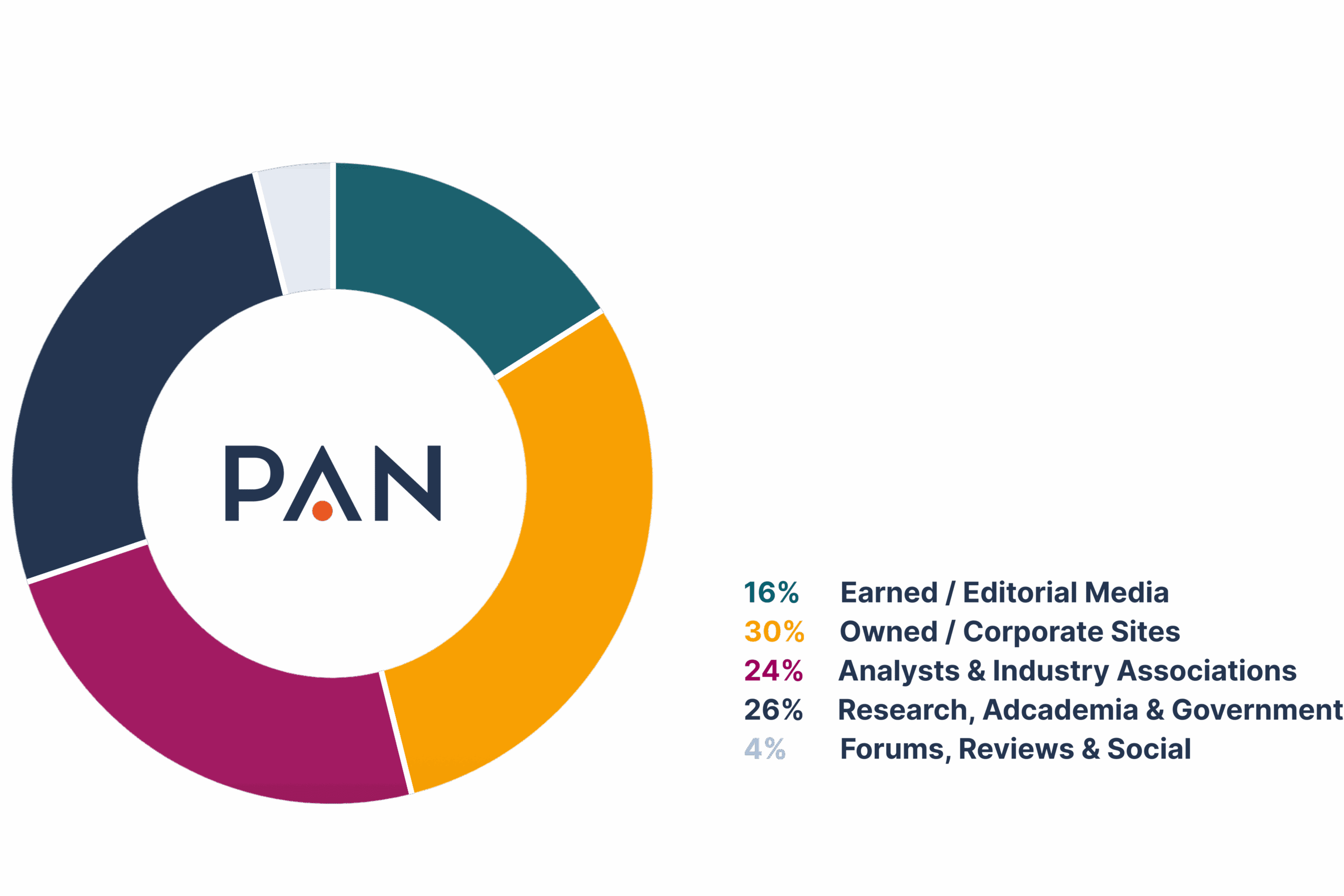
- Forty-four percent of all links executives encountered in ChatGPT came from PR-influenced sources (earned media, analysts, forums, reviews, and social).
- Thirty percent came from owned sources (corporate sites, blogs, and brand content).
- Every persona saw distinct publication and domain patterns that shaped the information they trusted.
Let’s break down a few personas from our research — and what kinds of content these executives gravitated toward.
Healthcare executives (like Henry) gravitate toward medical research and regulatory insight.
Where do I find this? On page eight of the C-Suite Signals report.
Henry’s top domains include arxiv.org, cdc.gov, jama network, and CMS.gov, showing a clear preference for research-heavy, evidence-based content. His Google searches skew toward care coordination, clinical staffing issues, and healthcare cybersecurity, signaling a blend of operational pressure and patient-safety concerns.
For marketers, this means healthcare executives will not respond to generic thought leadership. They want grounded, data-backed insights with clinical applicability.
Technical executives (like Ida and Denise) rely on security, cloud, and analytics sources.
Where do I find this? On pages three and seven of the C-Suite Signals report.
Ida’s top domains include deloitte.com, gartner.com, nist.gov, amazon.com, and sentinelone.com, while Denise’s discovery ecosystem reflects deep engagement with analytics-heavy, cybersecurity-adjacent outlets like Forrester, CNET, MIT Technology Review, and Analytics Insight.
This reinforces a critical truth: CIOs, CTOs, and CDOs gravitate toward content that demonstrates technical accuracy, process clarity, and security rigor.
Security leaders (like Steve) evaluate brands through the lens of risk.
Where do I find this? On page three of the C-Suite Signals report.
Steve’s top domains include cisa.gov, nist.gov, cybersecurity news sites, microsoft.com, and sans.org. His queries center on ransomware, defense in depth, and incident response. They all underscore a risk-aware mindset.
Marketing and financial leaders (like Micah and Petra) prize clarity, credibility, and business impact.
Where do I find this? On pages five and six of the C-Suite Signals report.
Micah’s ecosystem is dominated by Forrester, MarketingProfs, HubSpot, and McKinsey — a blend of marketing inputs and strategic analysis. Petra’s leans toward Deloitte, WSJ, CFO.com, EY, and KPMG, reflecting a preference for analytical content tied to measurable outcomes.
The New B2B Buyer Journey: 6 Trends to Monitor
Across all personas, we see six clear shifts in the B2B customer journey — trends that demand a different (or more concerted) approach to PR, content, and brand visibility. These shifts are best attributed to the following: (1) changing buyer behavior, and (2) how generative AI synthesizes and ranks the information executives rely on.
1. AI is now a top-of-funnel discovery engine.
Executives increasingly turn to AI as their starting point — not to make decisions outright, but to frame the problem, understand the landscape, and validate the criteria they should be considering. Instead of opening multiple tabs and searching dozens of keyword variations, ChatGPT becomes their first filter:
- “What should I consider when evaluating a cloud security platform?”
- “What KPIs matter most when reducing clinical workflow inefficiencies?”
- “Which marketing automation tools are best suited for mid-market teams?”
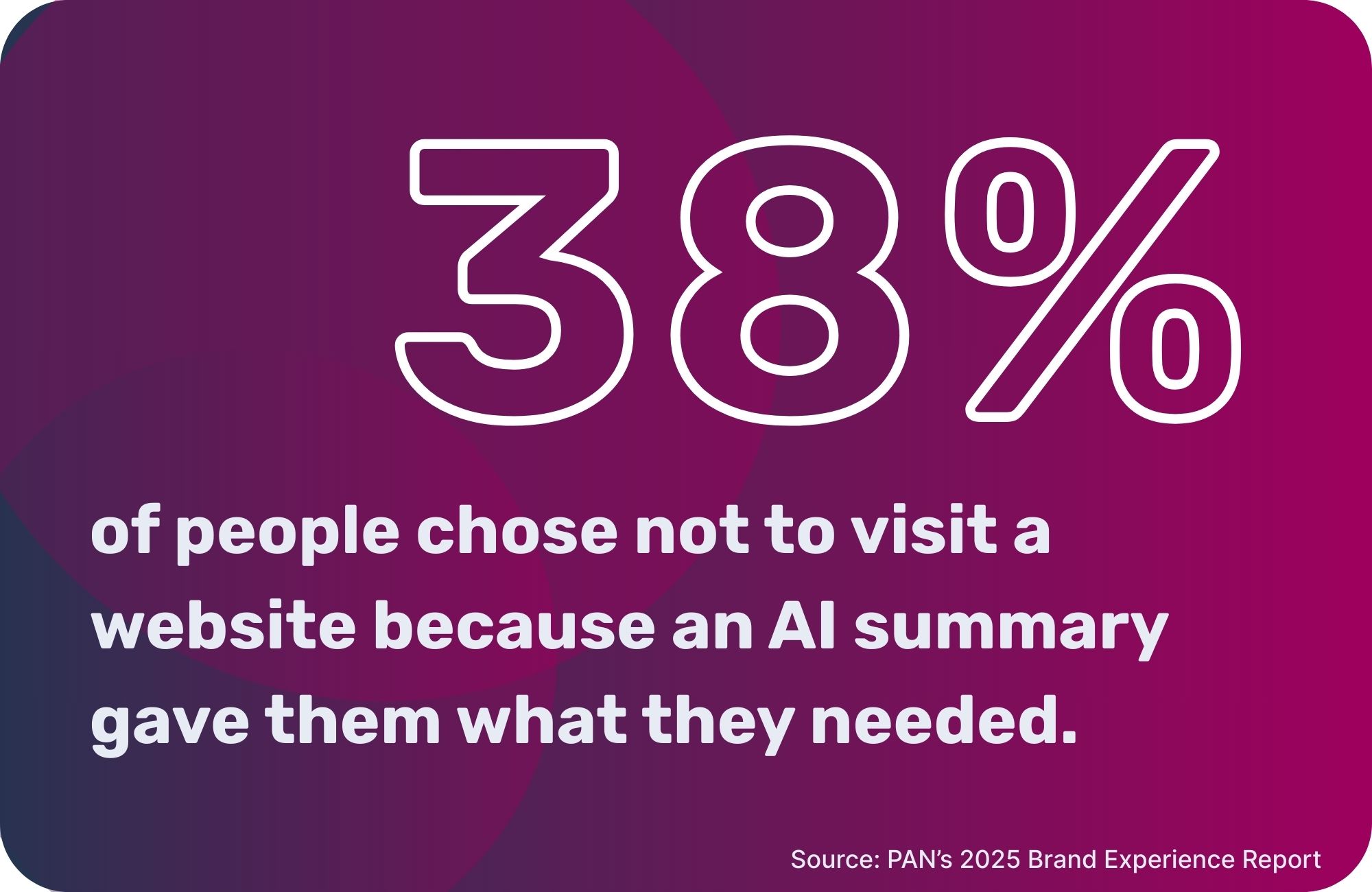
These summaries shape how executives think about categories before they ever encounter a vendor. AI sets the initial frame, shaping assumptions and decision criteria, long before a buyer reaches your website.
Our own AI Overview Tracker breaks this AI trend down further — and shows how frequently B2B terms now trigger Google AI Overviews (spoiler: it’s happening a lot more).
Related Read >> PAN’s B2B AI Overview Tracker
2. Each persona sees different sources and different brands.
This fragmentation is driven by role-based expectations. ChatGPT, and tools like it, tailor responses by pulling from sources it considers most authoritative for that persona’s domain.
That’s why:
- A CISO sees security-focused domains (CISA, SANS, NIST).
- A CIO/CTO is funneled toward cloud, DevOps, and data-infrastructure sources (Deloitte, Gartner, NIST, AWS documentation).
- A CMO sees marketing-specific thought leadership (Forrester, MarketingProfs, HubSpot).
- A Chief Medical Officer sees clinical, regulatory, and workforce-focused outlets (CDC, JAMA, AHRQ).
Each persona lives in a different digital ecosystem with different publications, terminology, problems, and vendors. If your brand is only visible in one ecosystem, you may be invisible in three others.
3. PR now has measurable influence on AI visibility.
In the past, PR’s value lived primarily in credibility and reputation. Today, it also plays a powerful role in training data, influencing what AI platforms “know” and repeat.
Our research found that 44 percent of AI-cited links came from earned or PR-influenced sources, including:
- Press coverage
- Analyst content
- Guest articles
- Executive interviews
- Podcast appearances
- Webinar transcripts
- Review-site commentary
Every earned placement becomes part of the content universe that generative systems draw from when they answer executives’ queries.
In other words, none of this happens in a vacuum. And your best brand initiatives will tie to each other — and to demand generation (more on that later).
Related Read >> Demand Generation vs. Brand Awareness? No, Growth Requires Brand-to-Demand
4. Owned content still matters…a lot.
With the increase of “PR is your silver AI bullet” messaging, it’s easy to forget the role of your owned content. But structured, semantically rich content helps AI understand:
- Your category
- Your expertise
- Your differentiation
- Your relevance to specific executive needs
Pages with clear definitions, comparisons, and contextual depth are far more likely to be surfaced in AI summaries than generic SEO fillers.
Related Read >> Generative AI Search Engine Optimization (Explained)
5. Review sites and directories inform discovery paths.
Review platforms still serve as validation layers that AI favors when generating shortlists. Of those platforms, ChatGPT most frequently cited:
- G2
- PitchBook
- Workable
- Gartner Peer Insights
- Cybersecurity review and threat-intelligence hubs
As executives rely more heavily on AI summaries, review-site presence becomes a visibility prerequisite.
6. Executives expect fast synthesis, not long-winded narrative.
GenAI has reset expectations around clarity, speed, and directness. Executives want content that mirrors the output they receive from generative tools:
- Concise
- Contextual
- Comparable
- Actionable
Brands that win are those whose content appeals to that demand while threading in humanity. Reminder: The robots may be good at delivering certain types of information, but they rely on content written by you, fellow human!
How to Reach C-Suite Executives in 2025: A 3-Step Framework Based on Persona-Specific Visibility
What you’ll notice, as you dive into these steps, is that the name of the game is integration. When your efforts are integrated, and when you integrate persona-specific content, you will stand a greater chance of being found by your buyer(s).
1. Build a persona-specific content ecosystem.
Executives gravitate toward sources aligned with their responsibilities and pain points. Our C-Suite Signals research makes clear which publications, domains, and formats matter to each persona — and that intelligence should guide your PR, content, and campaign planning.
A one-size-fits-all content strategy cannot reach six totally different executive ecosystems.
2. Optimize for AI-driven discovery and search.
Traditional SEO shapes how pages rank. But it can also feed into your AI optimization strategy, shaping how your ideas spread.
If you want to increase digital discoverability, consider the loose blueprint below:
- Answer common executive questions directly.
- Use structured, semantically rich content.
- Demonstrate real expertise, not generic commentary.
- Maintain consistency across earned and owned channels.
- Support clarity with schema, headings, and natural language.
Related Read >> Relevance Engineering: What Brands Need to Know
3. Connect PR, content, SEO, and demand into one unified visibility strategy
Executives don’t separate what they learn through earned media, owned content, peer reviews, analyst insights, or AI summaries. So, your visibility strategy shouldn’t either.
- PR fuels credibility and becomes training data for AI.
- Content fuels semantic understanding and topical authority.
- SEO fuels discoverability and structural clarity.
But the real trick here is integrating all three under a brand-to-demand strategy, or, a plan that links long-term brand storytelling with near-term demand activation. That alignment ensures:
- Your brand narrative is clear enough for AI to interpret.
- Your activation campaigns reinforce the category position established through PR.
- Your content ecosystem supports both awareness and measurable demand outcomes.
- Your visibility increases across both executive research paths and AI-curated summaries.
Brand-to-demand is how you avoid the “brand work vs. demand work” false dichotomy and instead create a unified strategy that fuels visibility across the full executive journey.
Related Read >> 6 Key Elements of Brand-to-Demand Marketing for B2B Success
The B2B Buyer Journey Is Fragmented, But You Have New Chances to Influence It
The modern B2B buyer journey is not searching linearly. They’re not predictable. And their behavior isn’t universal. The decision-making journey is shaped by each executive’s responsibilities, risks, pressures, and information preferences. With generative AI accelerating these divergences, brands must build persona-specific visibility across the environments that truly influence executives.
If you understand where each persona searches — and what content they trust — you can design a strategy that shows up at the exact moment they’re forming a point of view.