

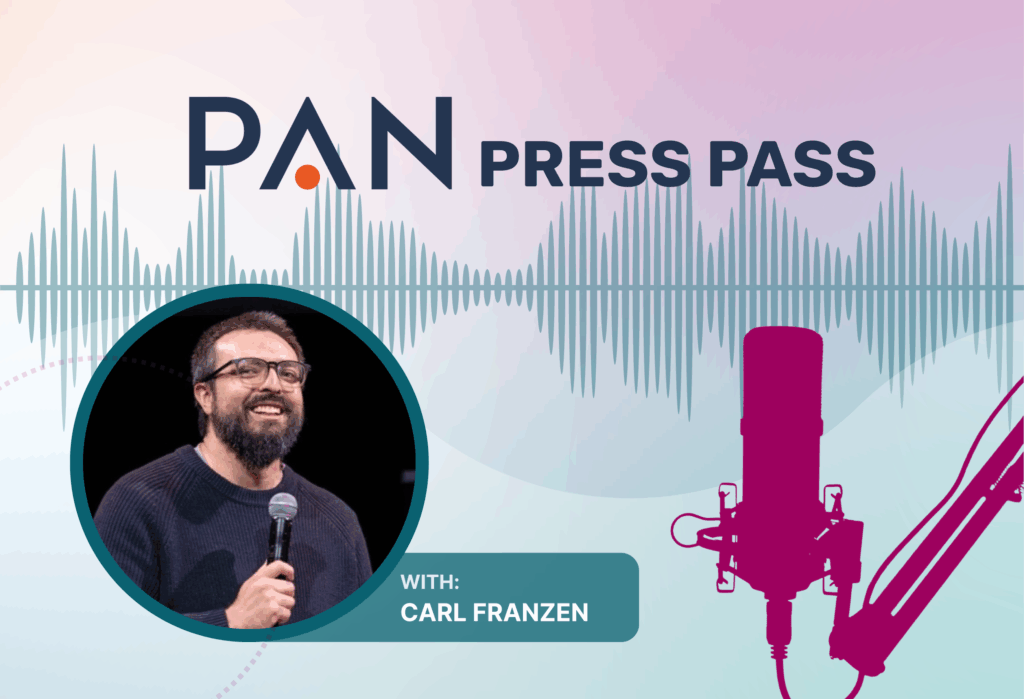
Understanding your outlet’s audience is the first step to grabbing a reporter’s attention. In this edition of PAN Press Pass, our reporter Q&A series, we speak with VentureBeat’s Carl Franzen, Executive Editor focused on the intersection of software, AI and media. Carl shares insights on the target VentureBeat audience and what his readers care about most, how to breakthrough the noise when it comes to AI stories, and the overall state of the media industry.
“Wait, what’s the PAN Press Pass?” The PAN Press Pass is a new Q&A series that spotlights a different journalist every month. In conversations that span vertical insight and best practice, our media team uncovers how journos approach and move forward in an increasingly turbulent media landscape.
This conversation with Carl Franzen marks the first installment. But stay tuned—more reporter insights are on the way, and we’ll be sharing them regularly to help you sharpen your media approach and strengthen your storytelling.
Related Read >> Reporter Q&A: Gabe Perna, Deputy Editor of Digital Health Business & Technology (a Modern Healthcare Brand)
Q: You’re an Executive Editor but you’re also a prolific writer. How do you spend your days?
Been mostly writing more than editing these days. We have such a small team, we’re writing at least one or two pieces per day. It’s me, Michael Nuñez, Emilia David our senior AI reporter, and a collection of freelancers who contribute a couple pieces a week. But it’s basically me, Mike, and Emilia who are the core staff of VentureBeat. We’re quite small so we’re quite busy. But it’s exciting stuff because we all like to write, so it’s not a bad situation at all!
Writing is the bulk of my day to day. I also go through different story ideas we get from PR and in-house communications folks of the companies we cover. And we do a lot of tracking on social media for new announcements that we didn’t get under embargo.
Q: How do you determine what to write? What stories do your readers care about most?
We all pinch hit and jump in wherever is needed, but a lot of what I write is breaking news, new product announcements, new features.
And to clarify our mandate, the audience we’re cultivating is what we call enterprise technical decision makers. It’s not necessarily the CEO, but maybe it’s the CTO or the people in charge of deciding what technologies to use to execute the CEO’s vision. We’re speaking to them. People who have more of an in-the-weeds view on what AI tools to use to accomplish their business goals. That guides a lot of our coverage. Once we have that set up as the lens, if we think that the audience will care about a story, it will determine if we cover a piece of news.
Q: What do you want PR people to know when it comes to pitching you?
Answer this question first: Is this something another business could use to help grow, make more efficient, or introduce a new capability to help with their goals? That’s the main question we want to have answered before we accept a story or do an interview. Is it something that will help one or more large sectors? It needs to be a wide enough facing product or offering that a number of enterprises would be interested in it. That’s how we decide whether to cover a piece of news.
Q: What are your thoughts on the state of the industry with so many newsrooms shrinking and layoffs taking place?
There was a moment in the early 2010’s that felt like digital media had lots of money and investors and we saw companies hiring and expanding to different verticals and platforms – but that time was short lived.
Since then, it’s been a move towards efficiency. Now they operate on as high of a margin, with as low of an overhead, as possible. It’s why our team is so small. It’s why a lot of well-known journalists with established followings are going to Substack or starting their own ventures. That’s the trend we’ve seen over the last few years. They can do the work without as big of a team as they had before. So that puts pressure on media as a business and makes it possible for small teams to survive and harder for large teams to justify the expense of having all those people.
Q: How much time do you need for an embargo pitch?
Depending on how big the news is, if it’s from a really big company we can usually do it the night before. It also depends on if the client or vendor wants to do an interview with us, in that case we need at least two days’ notice. Earlier if better, but a month out would probably be too far because things will change in the world. Anywhere from three weeks to two days is the sweet spot. Smaller vendors need to come to us at least a week in advance to make sure we can get what we need in order to cover them.
Q: With Agentic AI being such a hot topic, how do you decide what to cover?
I saw research that said most companies have not had a successful run with AI agents. Right now, there’s a lot of talk about it, but how much is it actually moving the needle for businesses. That’s the outstanding question right now and the answer may be “not very much.”
At our conference VentureBeat Transform, in San Francisco at the end of June, we heard about a lot of successful AI agent implementation. I think it’s a wide variance across the board. The companies that are succeeding with AI agents are often the ones partnering with cloud giants or vendors to implement agents that work for them.
There are definitely companies with examples of successful AI deployments, but I think it’s still early days, despite all the talk. Everyone is still trying to find their way around it. Definitely an overused term and there’s a trove of disillusion around it – but we’re not going to stop writing about it. For us to take on an AI agent story at this point, we need the level of in-practice how is it actually going, or we need a customer testimonial.
Everyone likes to think they are groundbreaking, but most things have at least been tried, or there is a similar product out there that fulfills the same function. The question then becomes “why is yours better?” Is it cheaper, easier to set up, does it offer a new capability that the business could benefit from? Answering those questions in the initial pitch goes a long way in piquing our interest and getting us more willing to cover something, given the volume of inbound information we receive.
Related Read >> The New Definition of “Top-Tier” Media
Pitching Is a Science and an Art: PAN’s Media Experts Nail Both
Whether you’re sharing a funding release or looking to secure a byline, you need a great pitch. A hook to keep reporters interested. An original point of view. And a narrative that pulls in your audience.
Looking for an agency that can pitch your brand and keep reporters wanting more? Get in touch with our Media Relations leaders.
